
The notion that Correa’s followers act primarily out of revenge, partisan motives, and even to serve the personal interests of their leader, Rafael Correa, has hampered their ability to gain support from other parties.
In the impeachment trial of Interior Minister Mónica Palencia, President Daniel Noboa’s administration has secured a 3-0 lead over the Citizen Revolution (RC) bloc in the National Assembly in terms of successful impeachments. This perception, which casts Correa’s supporters as prioritizing personal and political vendettas over genuine oversight, has hindered their efforts to gather enough support to achieve their goals.
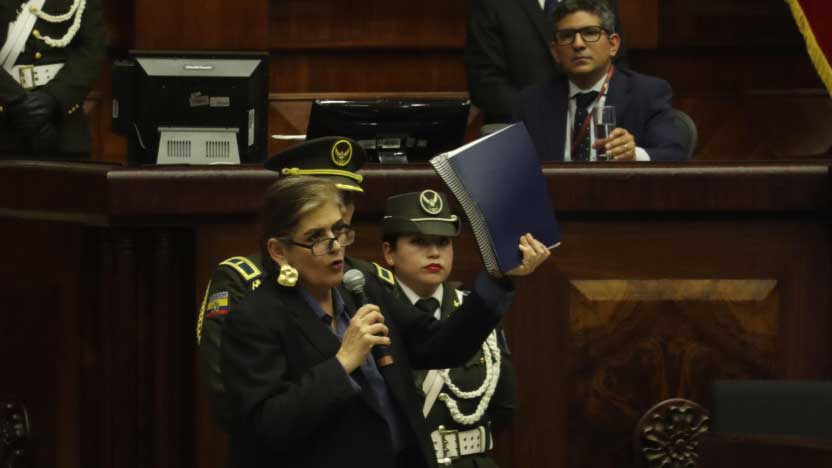
This pattern emerged in August 2024 with the attempted trial of Chancellor Gabriela Sommerfeld and was repeated in September with the trial against Prosecutor Diana Salazar—both motions ultimately being shelved. The trend continued on October 23rd, with a failed attempt to censure and dismiss Minister of the Interior Mónica Palencia, who, unlike her predecessors, defended herself directly before the Assembly.
Hours after her position was secured, Palencia was welcomed by President Noboa at the Carondelet Palace. Her appearance marked a unique chapter in Ecuadorian parliamentary impeachment proceedings, producing moments rarely seen in similar cases.
Full Cabinet
On the morning of October 23rd, Government Minister Arturo Félix Wong was seen walking through the halls of the Assembly, greeting arriving legislators for the 8:30 a.m. session. His presence raised eyebrows, particularly as he continued to roam among the seats before the session started. RC Assemblywoman Paola Cabezas voiced a complaint, leading legislative staff to politely ask Wong to leave the area.
“I just wanted to say hello… Let’s not confuse people; being friendly and saying hello isn’t a bad thing,” he said, adding that he had also come early because it was his birthday—a detail that went mostly unnoticed in the politically tense atmosphere.
One by one, other ministers, vice-ministers, and executive officials filled the Assembly’s western wing. The previous evening, a government representative had requested permission to allow at least three officials from each ministry to attend the session; the Assembly, citing limited space, declined. Among those who gained entry were Foreign Minister Gabriela Sommerfeld, Anti-Corruption Secretary Julio Neira, Defense Minister Gian Carlo Loffredo, and Environment Minister Inés Manzano, who also oversees Energy.
Meanwhile, news broke that the Mazar Reservoir was just two meters away from reaching its minimum capacity, deepening the country’s energy crisis.
The assembled officials cheered enthusiastically whenever Palencia’s name was mentioned—during her entry into the plenary, her speeches against Correa’s followers, and her departure from the Assembly.
Ace Up the Sleeve
The session’s punctual start—a rarity in the Assembly—was another surprise. Assembly President Viviana Veloz firmly urged both interpellants, Leonardo Berrezueta and Paola Cabezas, and Palencia to respect each other’s allotted speaking times.
The Correa supporters spent their two hours blaming Palencia for the nation’s security crisis, inadequate police support, rising violence, budget mismanagement, and the lack of a Phoenix Plan. Palencia responded to these points but did not overlook the primary accusation that had originally spurred her impeachment—a charge the interpellants conspicuously avoided mentioning.
“It seems the ‘comrades’ have left Jorge Glas on his own,” Palencia quipped, alluding to former Vice President Jorge Glas, who was arrested during a police raid on the Mexican Embassy in Quito on April 5, 2024. Palencia noted that Berrezueta had avoided discussing this key accusation, which alleged her involvement in the embassy raid.
“They included the embassy incident in the impeachment trial and harassed me over it. Now they’re silent and haven’t presented a single piece of evidence,” Palencia stated.
The benches’ suspicion was that by supporting Palencia’s censure, legislators might indirectly be seen as opposing Glas’s capture, an implication that Correa’s supporters tried to downplay by omitting it from the Oversight Committee’s report and the plenary impeachment trial.
“We couldn’t bring our evidence related to the embassy, and our witnesses didn’t appear… I admit I failed to address it,” Berrezueta later conceded, emphasizing that this omission would not affect the final resolution if the censure were approved.
A Cold Reception
Palencia’s response resonated with some legislators. Although RC had received word the previous day that the ruling party had 50 votes to support Palencia, they hoped Berrezueta and Cabezas’ arguments might sway the undecided.
However, the effect was the opposite. Construye, a faction that had been on the fence, announced after hearing “representatives of the worst in politics” that it would abstain from voting on Palencia’s censure and dismissal—a practical gesture of support. In a nuanced statement, Legislator Jorge Peñafiel expressed their opposition to both Correa and Noboa, stating they would abstain as a form of protest against both sides.
This shift dealt a blow to the RC bloc, whose members held a brief press conference to declare that Construye had effectively saved Palencia in exchange for political favors.
Berrezueta speculated this favor involved a guarantee for Construye’s assembly members’ candidate list registration for the 2025 elections, pending a decision from the Electoral Disputes Tribunal.
With Construye’s support of Palencia, the Social Christian Party (PSC) also made its stance clear. Their leader, Vicente Taiano, confirmed PSC’s support for the censure, underscoring their disapproval of Glas’s embassy arrest.
Ultimately, RC needed 92 votes to pass the motion, but secured only 77. The ruling party maintained its support with 40 votes against the censure and 17 abstentions. A vote reconsideration is pending.
A Call for Attention
Though many assembly members claimed to need Palencia’s testimony to form a decision, few were actually present or attentive during the nearly eight-hour session.
Members from the Citizen Revolution faction left their seats vacant during Palencia’s explanation of the Ministry of Interior’s budget management.
Assembly members from Construye and the PSC frequently exited the chamber for discussions on their final voting positions. President Viviana Veloz, on more than one occasion, asked the secretary to confirm quorum and register those present, causing delays. In response, Veloz firmly reminded members of their obligation to remain in their seats throughout the session.

0 Comments