
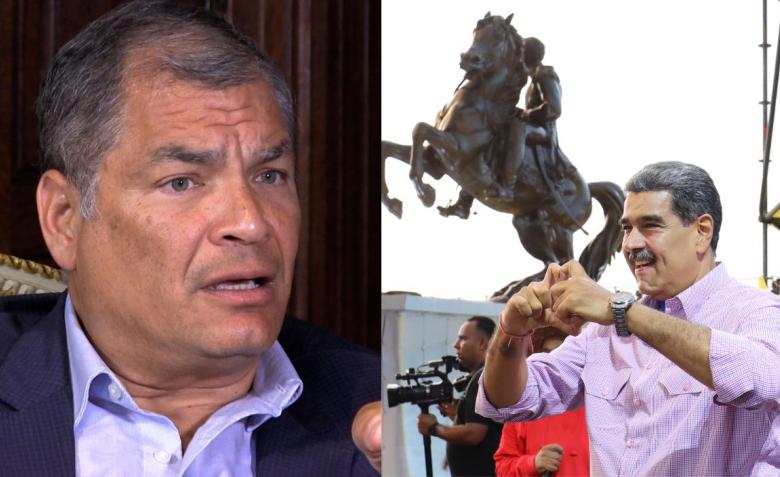
Former Ecuadorian president Rafael Correa acknowledges his role in advising Venezuela’s Nicolás Maduro, defending the Venezuelan leader amid international condemnation
In a stunning revelation during an interview with El Español, former Ecuadorian President Rafael Correa openly admitted to providing economic advice to Nicolás Maduro’s government in Venezuela. Correa, currently living in Belgium to avoid serving an eight-year prison sentence in Ecuador, shocked the public by acknowledging that two of his former ministers are permanently stationed in Venezuela, working as advisors to Maduro’s administration.
“It’s not that I work for Maduro; we’re Venezuela’s economic advisors. I have two people permanently there, my former economy ministers, who are doing an extraordinary job,” Correa confessed, a statement that had remained concealed during the 2025 presidential campaign in Ecuador.
Correa Defends Maduro, Blasts International Critics
Correa went further, defending Maduro, who is widely regarded as a dictator by the international community, describing him as “a very kind, peaceful human being.” The former president likened the vilification of Maduro to that of other historical figures, such as Hugo Chávez and José Mujica, who faced intense scrutiny for their political beliefs and actions.
While praising the economic recovery of Venezuela under Maduro’s leadership, Correa dismissed the country’s ongoing poverty and lack of formal employment as the result of international sanctions and a blockade on Venezuelan oil exports. “Just surviving is a success,” Correa claimed, framing the struggles as a consequence of external aggression rather than internal mismanagement.
This unexpected defense of the Venezuelan regime drew immediate backlash from critics, particularly as Correa’s ties to Maduro became clearer. His admission of direct involvement in the Venezuelan government contradicts his previous statements, leaving many in Ecuador and abroad stunned by the revelation.
Political Fallout in Ecuador
Correa’s admission could have significant repercussions for his influence in Ecuador. The former president’s relationship with Maduro was already a contentious issue during the 2025 presidential election. Luisa González, the Citizens’ Revolution candidate, found herself entangled in the controversy when, during the debate, she acknowledged she would recognize Maduro as Venezuela’s legitimate president if elected. This statement, which came after multiple evasions of the question, contributed to her eventual defeat by Daniel Noboa.
Correa’s openly admitted role as an advisor to Maduro could now lead to intensified scrutiny of the Citizens’ Revolution movement, which Correa still leads from Belgium. Critics have long questioned the movement’s alignment with 21st Century Socialism, and Correa’s newfound openness about his connection to the Maduro regime only strengthens those concerns.
The Broader Implications for Latin American Politics
Correa’s confession underscores the broader political currents in Latin America, where socialist movements and governments, from Venezuela to Bolivia, continue to promote anti-imperialist rhetoric while facing accusations of authoritarianism. Correa, who once proudly aligned himself with these movements, is now at the center of a diplomatic storm that could tarnish his legacy in Ecuador and beyond.
The admission also raises troubling questions about the future of Ecuadorian politics, particularly regarding Correa’s influence on current political leaders. As the crisis in Venezuela deepens, with millions fleeing the country, Correa’s role as an international advisor could serve to further isolate Ecuador from other Latin American nations that have distanced themselves from Maduro.
Maduro’s Supporters and Detractors
While Correa defends Maduro, he distances himself from direct political influence in Venezuela. “I don’t talk to Maduro every day,” he stated, stressing his consistency and lack of political gamesmanship. Yet, the timing of his admission—coming on the heels of Luisa González’s failed candidacy—seems to signal a strategic move to reaffirm his allegiance to Venezuela’s embattled government, regardless of the growing international condemnation.
As the Venezuelan crisis persists, Correa’s role as an advisor to Maduro could complicate his attempts to reintegrate into Ecuadorian politics, particularly as Ecuadorian voters remain divided over Correa’s legacy and the future of the Citizens’ Revolution.

It’s interesting how Correa’s statements are portrayed as “confessions” and “confessions” in this article.
Hello Jim, what’s your point?
Maduro, who is widely regarded as a dictator by the international community, describing him as “a very kind, peaceful human being.” Sounds like Trump talking about Putin.