
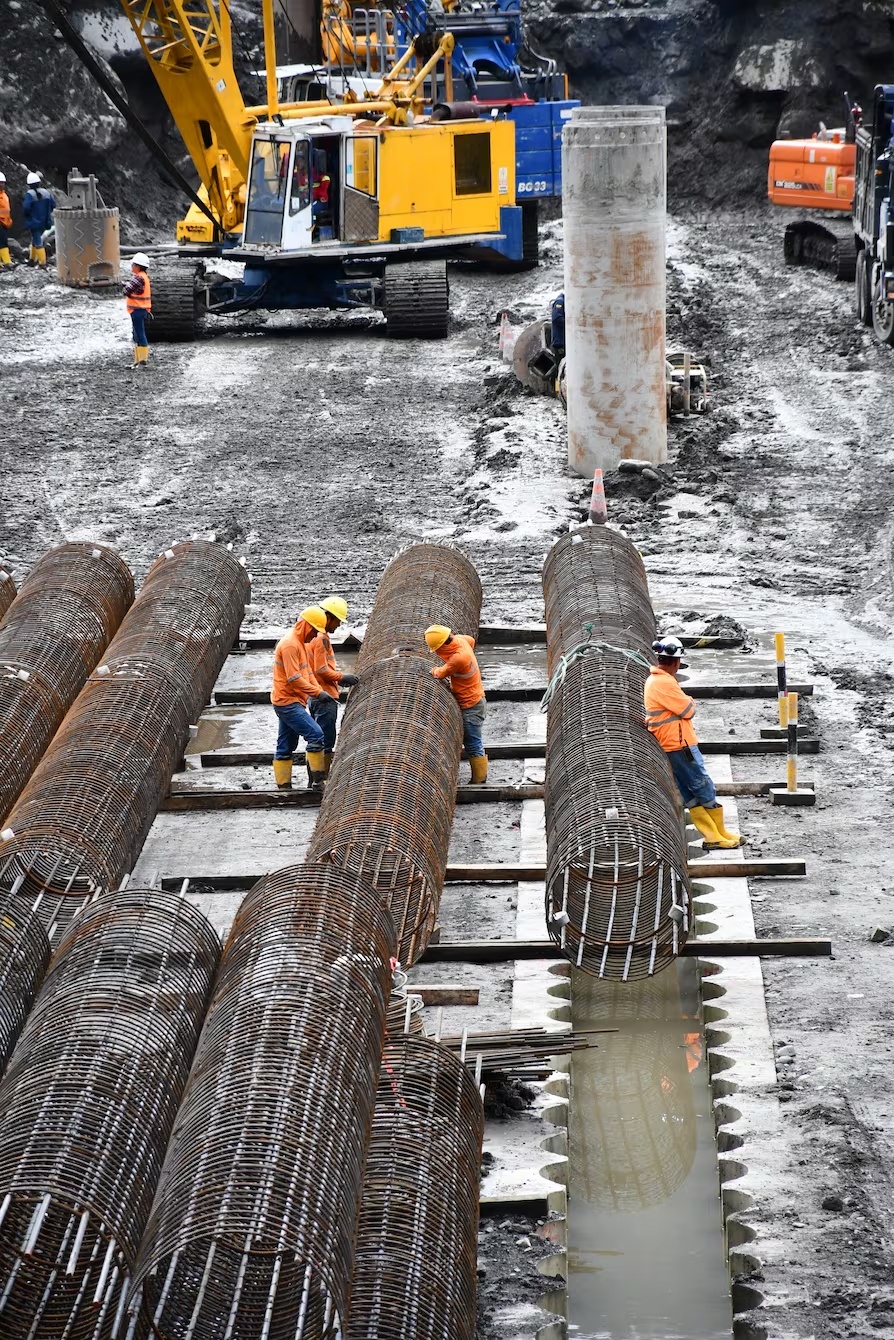
Engineers advance with protective works as regressive erosion continues downstream of Ecuador’s largest hydroelectric plant.
Dry season offers opportunity for works
Ecuador’s Electric Corporation (Celec) has confirmed that the regressive erosion of the Coca River does not currently threaten power generation at the Coca Codo Sinclair hydroelectric facility. The intake that channels water to the turbines lies upstream of the phenomenon, meaning production continues without interruption. According to the National Electricity Operator (Cenace), river flows will remain low between September 2025 and March 2026, providing a crucial window to advance mitigation works.
Celec explained that the dry months reduce sudden increases in river volume, which are the main accelerators of erosion. This pause in heavy flow allows engineers to strengthen defenses designed to stabilize the riverbed and protect infrastructure.
A unique natural process
The regressive erosion of the Coca River began in February 2020, when the San Rafael waterfall collapsed. That event altered the river’s dynamics, triggering lateral erosion that eats away at the banks and vertical erosion that deepens the river channel. As the process advances upstream, the erosion front slowly moves against the current, but so far it remains 3.6 kilometers downstream of the intake structure.
Recent surges in erosion were tied to intense rains recorded in June and July. Despite these fluctuations, Celec reports that the hydroelectric system remains fully operational. Continuous monitoring, carried out by the Coca River Executive Commission, produces updated reports every 48 hours, ensuring engineers respond quickly to changes.
Engineering solutions under construction
Celec is working with the United States Army Corps of Engineers on long-term measures to contain the erosion. One of the centerpiece projects is a permeable dam being constructed at kilometer 7.8 downstream from the plant intake. Now 60% complete, the dam includes a secant pile wall reinforced with large boulders. It will widen the Coca River channel from 80 to 200 meters, reducing water speed and weakening its erosive force.
The protective structure already shows positive results. Measurements indicate only one meter of elevation loss since its design level, proof, according to Celec, that the intervention is effective. Additional reinforcements, such as a quarry and diversion works planned at kilometers 3 and 9, will take advantage of hard rock formations to create natural barriers against further upstream advance.
Temporary defenses and adaptive strategies
While the permanent dam is completed, Celec is employing short-term safeguards. These include breakwaters made from large rocks to divert water away from fragile banks, and artificial channels to guide the flow and slow erosion. Smaller transverse barriers, known as sleepers, are also being installed to decrease the river’s erosive gradient.
In the La Loma camp zone, these measures have proven particularly effective, shielding installations from damage while construction continues. Celec has also finished Stage 0 of intake protection, consisting of a pile wall located 1.2 kilometers downstream, acting as a preliminary shield against the erosion front.
Looking ahead
Celec stresses that the combination of permanent engineering projects and temporary reinforcements provides security for Coca Codo Sinclair during the upcoming dry season. With hydropower providing a major share of Ecuador’s electricity, the corporation insists that maintaining the stability of the Coca River is not only an engineering challenge but a national priority.

0 Comments