
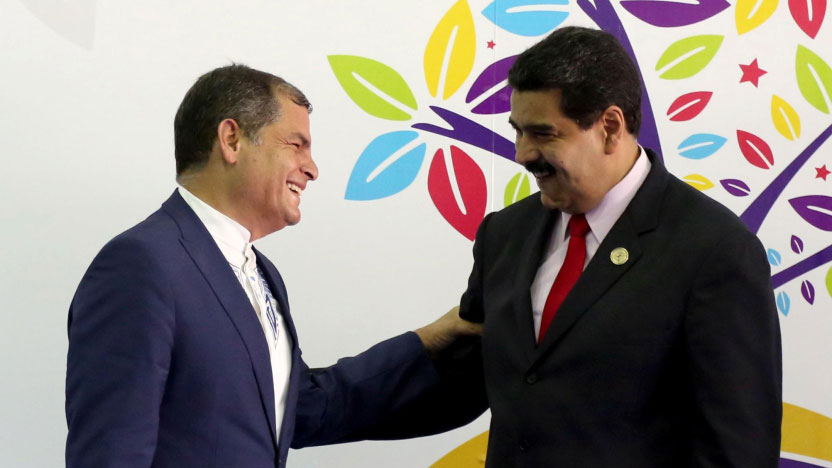
After Maduro’s ouster, Ecuador’s Citizen Revolution risks losing political shelter, financial pipelines and a regional ally.
A political friendship under strain
The sudden collapse of Nicolás Maduro’s government in Venezuela has sent shockwaves well beyond Caracas, and few movements feel it more sharply than Ecuador’s Citizen Revolution. For nearly two decades, Correísmo built its international identity around an unbreakable alliance with Chavismo, even as much of Latin America’s left drifted away from Venezuela’s increasingly authoritarian project.
That loyalty came at a price. While leaders such as Brazil’s Lula da Silva, Mexico’s Andrés Manuel López Obrador, Chile’s Gabriel Boric and Colombia’s Gustavo Petro distanced themselves from Maduro after disputed elections and reports of repression, Rafael Correa and his political heirs remained firmly in the Venezuelan camp. In Ecuador, that stance steadily eroded their appeal as millions of Venezuelans fled their country and settled across the region, including in Ecuadorian cities that absorbed the social and economic shock of the migration wave.
Now, with Maduro removed and an interim government led by Delcy Rodríguez taking power, Correísmo faces a new and uncomfortable reality: the ally that once provided ideological cover, financial oxygen and political refuge may no longer be able—or willing—to do so.
The roots of a deep alliance
The bond between Chavismo and Correísmo was never just rhetorical. It was forged in the early days of Rafael Correa’s presidency, when Hugo Chávez stood beside him at his 2007 inauguration, signaling the birth of a new left-wing axis in South America. That alliance was later cemented in Ecuador’s Montecristi Constitution, whose framers were advised by Spanish political figures who had already shaped similar charters in Venezuela and Bolivia under the banner of 21st-century socialism.
Through regional blocs such as ALBA, CELAC and UNASUR, Quito and Caracas coordinated diplomacy, development strategies and political messaging. Dozens of bilateral agreements followed, spanning energy, finance, defense, migration and social programs. These were not symbolic gestures; they created institutional links that tied the two governments together at multiple levels.
One of the most ambitious initiatives was the Ecuador–Venezuela Development Fund, known as Fevdes, designed to finance productive projects through investments and repayable loans. Energy cooperation was even more central. Petroecuador and Venezuela’s PDVSA promoted the idea of a massive Pacific Refinery in Ecuador, a flagship project meant to anchor the two countries’ oil strategies. Hundreds of millions of dollars were spent before the refinery was quietly abandoned, later becoming the subject of corruption and illicit association investigations.
Money, oil and a parallel financial system
Beyond oil, Quito and Caracas experimented with alternative financial structures aimed at reducing dependence on the U.S. dollar. The most controversial was SUCRE, a virtual currency created to facilitate trade within the Bolivarian bloc. In practice, it opened the door to massive irregularities. Ecuador became a hub for fictitious exports and suspicious financial flows that later drew the attention of U.S. investigators probing international money-laundering networks.
These mechanisms flourished during the Chávez years and carried over, albeit with less stability, after Maduro took over in 2013. Even as Venezuela’s economy collapsed and its international isolation deepened, Correa’s movement tried to keep the ideological flame alive through forums such as the Latin American Progressive Encounters held in Quito between 2014 and 2016. The goal was to rally like-minded movements and preserve the regional socialist project.
But history moved in the opposite direction. A conservative wave swept several countries, UNASUR disintegrated, and ALBA faded into irrelevance. In Ecuador, Alianza PAIS imploded, corruption cases mounted, and Correa went into exile. It was at that point that Maduro’s Venezuela became more than a political ally; it became a lifeline.
Caracas as refuge and financier
As Ecuadorian courts pursued senior figures from Correa’s former government, Caracas emerged as a safe harbor. Former officials accused or convicted of corruption found protection there, including ex-communications secretary Fernando Alvarado, former transport minister María de los Ángeles Duarte and ex-lawmaker Ronny Aleaga. Their presence in Venezuela was a constant reminder that the Chavista state was willing to shield Correísmo’s embattled leadership.
Financial ties were just as important. In 2019, revelations surfaced that the Eloy Alfaro Institute of Political Thought, led by Correa, had received funds from Venezuela’s Development Bank, Bandes. Those resources allegedly flowed to a network of close allies, including Ricardo Patiño, Patricio Rivera, Diego Martínez, Fausto Herrera and Leonardo Orlando. Rivera and Herrera later served as economic advisers to the Maduro government, working directly with Delcy Rodríguez, then vice president and economy minister. Correa himself acknowledged receiving a salary from Caracas for consulting work.
The same financial corridors were also implicated in a separate international scandal involving Spain’s Podemos party, which was accused of receiving early campaign financing routed through Ecuador from Venezuela. Many of the Spanish figures linked to that case were the same advisers who had once helped draft Ecuador’s constitution in Montecristi, underscoring how intertwined these political networks had become.
An ideological island
By the time Maduro was pushed from power, Correísmo had become one of the last movements in the region still defending the Venezuelan model without hesitation. While much of the Latin American left continued to oppose U.S. intervention in principle, most governments opted to emphasize Venezuelan sovereignty rather than endorse Caracas’ internal repression. Only a small circle of states—Cuba, Nicaragua, Russia, China and Turkey—maintained the kind of unconditional support that Correa’s movement extended to Chavismo.
That isolation mattered. In Ecuador, it coincided with three consecutive electoral defeats in 2021, 2023 and 2025, as voters increasingly associated Correísmo with a foreign dictatorship at a time when Venezuelan migrants were visibly struggling to survive in Ecuadorian streets and shelters.
What changes under Delcy Rodríguez
The irony of the current moment is that Delcy Rodríguez, the interim president who stepped in after Maduro’s fall, is personally close to Correa. She worked with his advisers, paid him as a consultant and was part of the same inner circle that kept the Ecuadorian movement afloat during its darkest years.
Yet geopolitics may now override friendship. With Washington heavily involved in shaping Venezuela’s transition, any continued backing for Correísmo—or for Ecuadorian figures facing corruption charges—could become a liability for the new government in Caracas. Financial channels that once flowed quietly through banks and foundations may come under scrutiny, and political asylum may no longer be guaranteed.
For the Citizen Revolution, the risk is existential. Losing Venezuela would mean more than the disappearance of a friendly voice abroad. It would mean the collapse of a support system that provided money, protection and ideological validation long after those assets were gone at home.
As Latin America’s left recalibrates in the wake of Maduro’s downfall, Correísmo finds itself stranded between a past that no longer exists and a future that offers few allies. In that sense, what happened in Caracas may prove to be one of the most consequential political earthquakes Ecuador’s opposition has felt in years, even though it unfolded hundreds of miles away.

0 Comments