
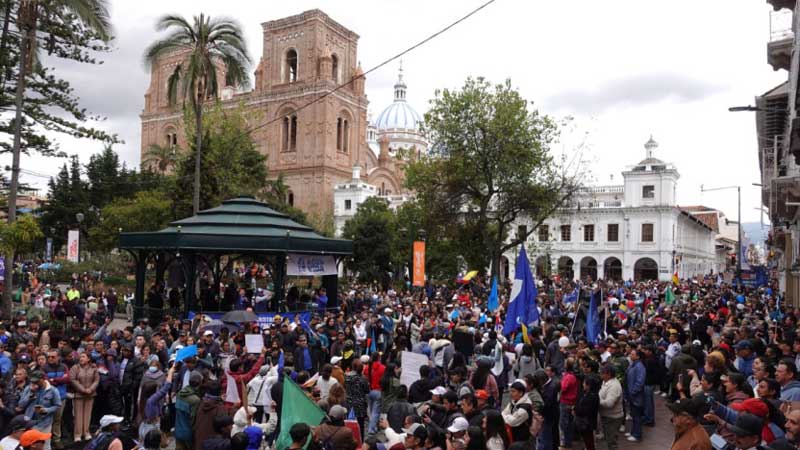
Opposition to mining, institutional clashes, financial shock and strained public services defined the city’s most turbulent year.
Cuenca spent much of 2025 pulled into national debates that went far beyond local concerns. What began as a dispute over a mining project near a protected water source quickly widened into open political conflict, institutional breakdowns and growing public frustration with essential services. By year’s end, the city found itself grappling with questions of governance, trust and the limits of local power.
Mining opposition was the spark, but it was not the only force shaping the year. Financial instability hit close to home with the collapse of a major cooperative, while hospitals struggled under budget cuts and shortages. At City Hall, audit reports triggered new confrontations between municipal authorities and national oversight bodies, deepening a climate of tension that rarely eased.
Water, mining and a city mobilized
Few issues galvanized Cuenca in 2025 as powerfully as the Loma Larga mining project. Plans by the Canadian firm Dundee Precious Metals to advance toward the exploitation phase near the Quimsacocha area placed the city at the center of a national environmental dispute. The company argued that prior consultation had been completed and that it had secured an environmental license, clearing the way for a multimillion-dollar investment.
Those claims were immediately challenged by local organizations and authorities, who questioned both the consultation process and the environmental approval itself. Concerns over water security and the proximity of mining activities to a protected ecosystem quickly turned into mass mobilization. On September 16th, streets across Cuenca filled with demonstrators in what became known as the March for Water, drawing an estimated crowd of more than 100,000 people.
Sustained pressure from citizens, the municipal government and the Azuay Prefecture eventually forced a political reversal. In early October, President Daniel Noboa announced that the project would not move forward, and days later the Ministry of Environment and Energy revoked the environmental license. Even so, skepticism lingered. Community groups continued to demand that the mining concessions themselves be canceled, wary that the project could resurface under a different legal framework.
A fractured relationship with the central government
The mining dispute exposed and accelerated a broader deterioration in relations between Cuenca’s municipal leadership and the national government. Mayor Cristian Zamora emerged as one of the most outspoken local critics of the executive branch, and exchanges between city and state officials grew increasingly personal and public.
One of the sharpest confrontations came after the environment minister accused ETAPA, the municipal water company, of providing misleading information about environmental impacts linked to the mining project. Zamora pushed back forcefully, defending the company’s technical credibility and questioning the ministry’s decisions. Similar clashes followed with other national figures, including the government’s former spokesperson and the provincial governor, each exchange reinforcing the sense of institutional distance.
The rift was symbolically visible during Cuenca’s independence celebrations in November, when local and national authorities marked the anniversary separately. For many residents, the absence underscored how deeply political disagreements had spilled into civic life.
Financial shock from a cooperative collapse
While political disputes dominated headlines, an abrupt financial crisis shook thousands of families in July. The Superintendency of Popular and Solidarity Economy ordered the suspension of operations of the CREA savings and credit cooperative, one of the largest financial institutions in southern Ecuador, citing mismanagement.
Nearly 100,000 members were affected, and scenes of anxiety played out as depositors rushed to understand whether their savings were safe. Authorities later transferred tens of millions of dollars in assets and liabilities to other cooperatives to protect most members, and repayments began within weeks. Still, several hundred account holders were left waiting for funds tied to the liquidation of remaining assets, a reminder of the fragility of trust in financial institutions.
Hospitals under strain and lives at risk
Public healthcare in Cuenca reflected a nationwide crisis but carried its own local consequences. Hospitals faced persistent shortages of medicines and supplies, compounded by staff overloads and aging equipment. At the Vicente Corral Moscoso Hospital, budget cuts compared to the previous year intensified existing problems, pushing medical personnel to the brink.
At the Social Security Hospital José Carrasco Arteaga, patients reported long delays for both general and specialized care. The system’s strain became impossible to ignore after reports of a serious medical error involving a misdiagnosed patient and, more tragically, a health emergency in indigenous communities of Morona Santiago. The deaths of several children in Taisha raised alarms about delayed care and unequal access to health services in the southern region.
Audits, contracts and new legal battles
As the year closed, scrutiny shifted back to municipal administration. The Comptroller’s Office released preliminary audit findings on a series of contracts signed under both the previous and current city governments. Among the most controversial was the purchase of an armored vehicle for the mayor, which auditors said showed indications of criminal liability.
Mayor Zamora rejected the findings, framing them as politically motivated and accusing the oversight body of harassment. His response prompted a sharp rebuttal from the Comptroller’s Office, which defended its independence and warned of possible legal action in response to what it described as intimidation.
A separate audit revisited the terminated radar contract with Móvil Technology, originally signed under a prior administration and canceled by Zamora in 2023. Auditors again identified potential criminal responsibility, ensuring that disputes over accountability would carry into the following year.
By the end of 2025, Cuenca had weathered protests, institutional clashes and crises that tested both its civic cohesion and its political leadership. What remained was a city more aware of its collective power, but also more sharply divided over how that power should be exercised—and at what cost.

0 Comments