
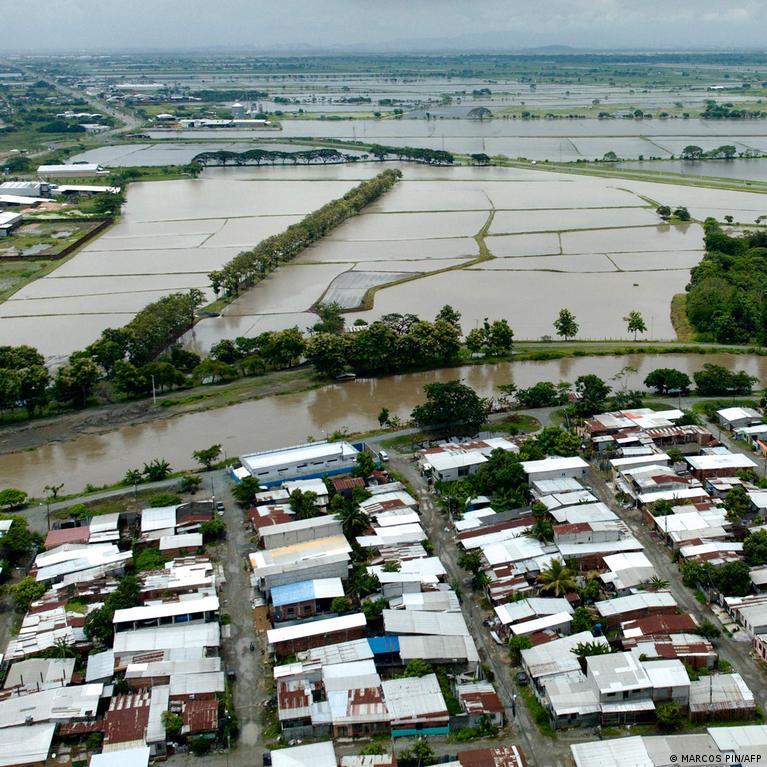
Farm losses could reach two million hectares as officials prepare insurance and recovery measures.
Ecuador’s agricultural sector is preparing for a potentially severe blow from the 2026-2027 El Niño phenomenon, with government officials warning that flooding, crop damage and disruptions to planting could affect hundreds of thousands of producers along the coast.
The Ministry of Agriculture, Livestock and Fisheries says the country could lose up to 2 million hectares of agricultural production in the worst-case scenario. Even under a more moderate forecast, officials estimate that 500,000 hectares could be affected, making the climate event one of the most serious risks facing the rural economy in the coming months.
Agriculture Minister Juan Carlos Vega said on July 1st that the most vulnerable areas will be low-lying coastal zones, where heavy rains and flooding can quickly damage fields, roads, irrigation systems and aquaculture operations. The strongest effects are expected between October 2026 and January 2027, a period that overlaps with critical planting and production cycles.
Coastal crops face the highest risk
Officials expect the greatest damage in crops grown near sea level, particularly rice, corn and bananas. Shrimp farms are also considered vulnerable, as flooding, water-quality changes and damage to infrastructure could disrupt production in one of Ecuador’s key export industries.
Los Ríos is expected to be among the hardest-hit provinces, although officials say the entire coastal region remains exposed. The province is one of the country’s most important agricultural areas, especially for rice, corn, bananas and other crops that depend on stable planting conditions and access to markets.
Vega said shortages would most likely appear in January if the climate event causes major losses during planting season. In that scenario, the government could consider importing corn or rice to stabilize supply and prevent pressure on prices.
The ministry has estimated the potential economic impact of a worst-case agricultural loss at about $1.3 billion, although the broader effects could extend beyond the value of damaged crops. Flooded farms can also leave producers without income for months, increase transportation costs, reduce employment in rural areas and delay future harvests.
Government rolls out contingency plan
To reduce the impact, the Agriculture Ministry and the Inter-American Institute for Cooperation on Agriculture presented a national contingency plan for the 2026-2027 El Niño event. The plan is designed to protect agricultural, livestock, aquaculture and fishing production before, during and after the climate phenomenon.
The government says the plan includes 62 specific actions, ranging from early warnings to technical assistance and recovery support. The ministry has allocated $19.7 million for the response effort, which will be carried out in phases as conditions develop.
The first phase focuses on prevention. It includes early warning systems, plant and animal health monitoring, and efforts to encourage producers to enroll in subsidized agricultural insurance. Officials say advance preparation is essential because many of the expected losses can be reduced if farmers receive timely alerts and technical guidance.
Insurance becomes central to protection effort
Subsidized Agricultural Insurance is one of the main tools in the government’s plan. Officials describe it as a financial protection mechanism for producers who suffer losses caused by El Niño-related damage.
For the 2026-2029 period, the agricultural insurance program has a budget of $24.5 million. Of that amount, $17.9 million will be used to subsidize insurance premiums for producers, covering between 60% and 80% of the cost.
The government expects the insurance program to cover about 215,000 hectares, 96,000 animals and 79,608 producers during that period. The goal is to give small and medium producers a way to recover at least part of their losses if crops, livestock or production systems are damaged.
Recovery aid will follow damage assessments
Once the event is underway, the response phase will focus on constant monitoring, damage assessments and support for affected producers in the field. Technical teams are expected to work in vulnerable areas to evaluate losses and activate assistance programs.
The recovery phase will include the distribution of technology packages, certified seeds, tools and specialized technical assistance. It will also involve support for irrigation systems and financing mechanisms to help producers restart operations after floodwaters recede or damaged infrastructure is repaired.
Officials say the plan is intended not only to respond to emergencies, but also to shorten the time it takes for farmers, shrimp producers and fishing communities to return to production. With the strongest effects expected late this year and into early 2027, the coming months will test whether Ecuador can move quickly enough to protect its coastal economy before the heaviest rains arrive.
0 Comments