
Imports, emergency repairs and rationed logistics are being used to keep key supplies moving nationwide.
Ecuador’s fuel supply system is under mounting pressure after a fire at the Esmeraldas Refinery knocked out operations at the country’s largest refining complex, forcing Petroecuador to rely on emergency imports, logistical changes and a partial restart plan to prevent shortages of jet fuel, domestic gas and asphalt.
The March 1st blaze damaged critical equipment and electrical systems at the state-owned refinery, setting off a chain reaction that shut down multiple processing units and ultimately halted operations across the complex. In the days since, company officials have moved to contain the fallout by declaring an emergency, accelerating repairs and reorganizing distribution to protect fuel supplies in key regions of the country.
The situation is especially delicate because the Esmeraldas Refinery plays an outsized role in Ecuador’s energy chain. Any prolonged interruption there can quickly spill into transportation, aviation, public works and household fuel distribution, raising the stakes of every day the facility remains below normal capacity.
How the fire started
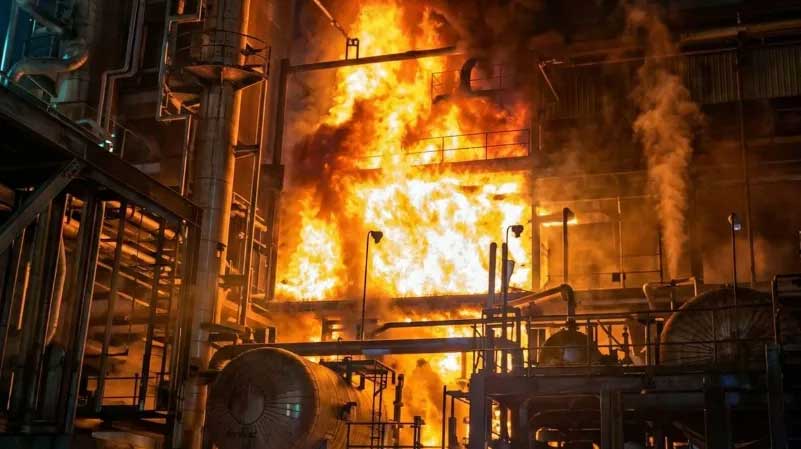
According to technical reports prepared by refinery officials, the fire began at about 7:15 p.m. on March 1st in Viscoreductor Unit 1 during maneuvers carried out ahead of restarting the plant. The reports say diesel escaped through the seals of the TV-P2B pump while recirculation work was underway, and the fuel then ignited.
What followed was a major industrial fire that shot flames to an estimated height of 30 meters and required an aggressive emergency response. Firefighters and refinery brigades opened three separate fronts to attack the blaze, which was finally brought under control around 9:30 p.m.
No deaths were reported, but the refinery itself suffered heavy damage. The heat and loss of instrumentation signals affected nearby operating areas and forced the shutdown of Crude Unit 1, Vacuum Unit 1 and other systems that could no longer be run safely. With key controls compromised, the refinery moved into a full shutdown.
Damage spread well beyond the ignition point
The fire’s immediate origin may have been confined to one unit, but the consequences extended across a much broader section of the complex. Inspection reports describe damage to pumps, air coolers, valves, pipes, motors, electrical wiring and metal structures, showing that the event was not limited to a single isolated piece of equipment.
Some pumps were left incinerated or visibly deformed. Air coolers were destroyed or placed out of service. Valves and piping were warped by thermal radiation. Electrical systems also took a major hit, with damaged motors and wiring complicating any quick return to service.
Refinery technicians also identified signal loss in more than 300 instruments throughout different units of the complex. That loss is one of the most serious barriers to a restart because a refinery cannot safely operate if instrumentation is unable to monitor pressure, temperature, flow and other basic process conditions.
The technical conclusion was blunt: under existing conditions, the affected units cannot be operated until instrumentation is restored, the mechanical integrity of the equipment is verified, and safe operating conditions are reestablished throughout the plant.
Repairs face a spare-parts problem
The challenge is not just the extent of the damage, but also the lack of readily available replacement components. Technical personnel reported that there were no immediate stocks on hand for several critical parts needed to restore operations.
Among the missing items are transmitters, control valves, sensors, instrumentation cables and electronic modules. Without those components, even units that appear structurally intact cannot simply be switched back on.
That shortage has made the refinery’s recovery timeline more uncertain and explains why Petroecuador moved on March 5th to declare a state of emergency. The measure is intended to streamline contracting and procurement so that work, goods and specialized services can be hired faster than under normal procedures.
Petroecuador manager María Daniela Conde said the emergency declaration was necessary to speed up repairs and restore operability to the complex. Technicians, meanwhile, recommended comprehensive maintenance of Viscoreductor Unit 1 along with broader intervention in damaged areas before the refinery can return to normal.
Only a partial restart is in sight
For now, the company’s plan is not a full reopening but a gradual recovery. Officials say the first step will be the restart of Crude Unit 2 and Vacuum Unit 2, a move that would bring the refinery back to roughly half of its normal operating level.
That partial resumption is expected to begin on March 16th, according to the latest operational plan. Even then, Ecuador will still be running with a significant gap in domestic refining output, meaning imports and distribution adjustments will remain essential.
The Esmeraldas Refinery normally processes about 110,000 barrels of oil per day, making it a pillar of the national fuel system. Petroecuador has indicated that reaching full processing capacity may not be possible until May 2026, assuming repairs proceed without further disruption.
That long runway has elevated concerns not only about fuel inventories, but also about how much strain the broader supply chain can absorb over the next several weeks.
Fuel distribution enters emergency mode
To keep the domestic market supplied, Petroecuador has begun reshuffling imports and internal logistics. The company’s own emergency documents warn that the refinery shutdown could affect important parts of the state oil chain, particularly in the north-central corridor that depends on refined products moving inland from Esmeraldas.
Among the terminals identified as vulnerable are Santo Domingo, Beaterio in Quito, Ambato and Riobamba. Reduced output from Esmeraldas means those areas may need to rely more heavily on imported product, increasing pressure on maritime terminals, unloading schedules and storage infrastructure.
Officials have also warned of possible downstream effects on the Esmeraldas–Santo Domingo–Quito pipeline if replacement supplies cannot be maintained through imports. That raises the possibility of wider logistical stress extending beyond the refinery fence line and into the transport system that serves major consumption centers.
The government’s strategy, at least for now, is to stay ahead of shortages by shifting volumes, expanding import operations and prioritizing the most sensitive products.
Jet fuel emerges as the most urgent concern
Among all the products affected by the shutdown, Jet A1 appears to be the most immediately vulnerable. Internal marketing reports dated March 3rd showed thin inventories at Ecuador’s two principal airports, raising the risk of disruption to commercial aviation if resupply is delayed.
At Quito’s Mariscal Sucre airport, available stock was estimated at about five days. At Guayaquil’s José Joaquín de Olmedo airport, reserves were said to be closer to four days. Those are narrow margins for airports that depend on continuous fuel flow to keep passenger and cargo traffic moving.
If the supply chain falters, airport authorities could be forced to issue an international NOTAM alert over fuel shortages. That would create immediate consequences for airlines, which could face flight suspensions, route changes or rescheduling. The effects would likely ripple far beyond the aviation sector, touching tourism, cargo logistics and trade at a time when reliability in transport remains crucial.
The threat of aviation disruption has therefore become one of the clearest measures of how serious the Esmeraldas shutdown could become if repairs or imports fall behind schedule.
Asphalt shortage threatens road projects
The refinery shutdown is also hitting an entirely different corner of the economy: road construction. Esmeraldas is Ecuador’s only asphalt production center, making it indispensable for public works projects around the country.
With the refinery offline, asphalt shipments are expected to remain suspended until at least the end of March. That has already raised concern among local governments and contractors that depend on a steady supply for paving and maintenance.
In Quito, municipal authorities have warned that roughly 100 kilometers of road work could be halted because of the interruption. That means the fire is no longer just an industrial event in Esmeraldas; it is already affecting infrastructure plans in other cities and exposing how closely connected public works are to refinery operations.
If the suspension lasts longer than expected, more municipalities could find themselves forced to postpone scheduled repairs or absorb higher costs tied to delayed execution.
Domestic gas supply is being rerouted
Household fuel distribution has also required rapid adjustments. Petroecuador temporarily suspended tanker truck shipments of domestic gas from the refinery and has concentrated supply through the Gasito bottling plant, while diverting part of demand to the Chorrillos terminal.
The goal is to prevent a direct hit to households that rely on liquefied petroleum gas for daily cooking. Although officials have not announced a broad shortage in domestic gas, the operational changes show that normal supply routes are no longer functioning as they did before the fire.
Those changes also underscore a larger problem revealed by the incident: Ecuador’s energy system remains highly exposed when one strategic installation goes offline. A fire in a single refinery has now forced changes in aviation, road construction, inland terminal operations, maritime unloading schedules and home gas distribution, all within a matter of days.
For Petroecuador, the next few weeks will be a test not only of its repair capacity, but of whether it can keep the country supplied while one of its most important industrial assets struggles back to life.
0 Comments