
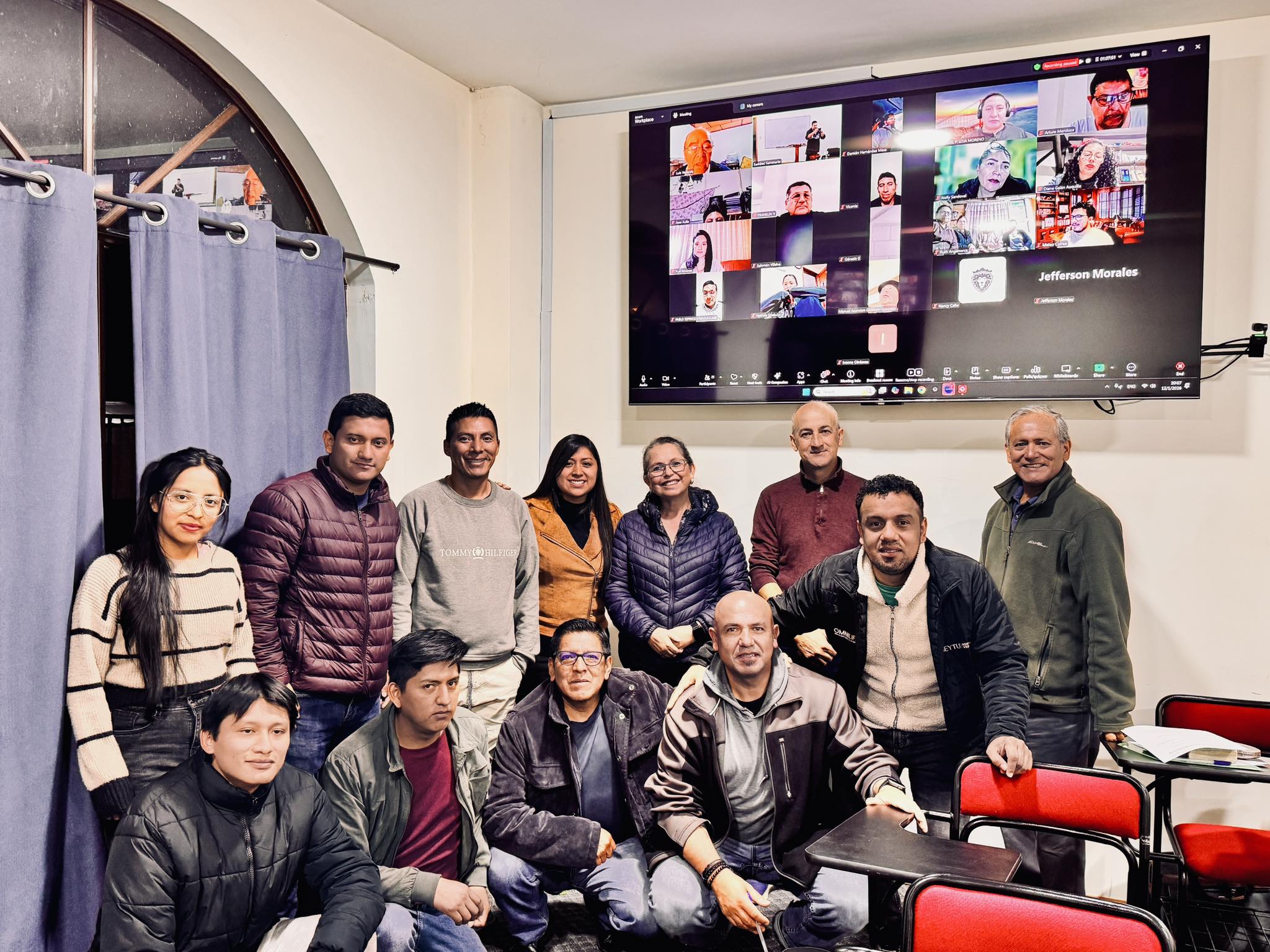
An evangelical institution blends local classrooms with real-time digital learning, reaching Spanish-speaking students worldwide.
For much of southern Ecuador’s history, advanced theological education came with a non-negotiable requirement: physical presence. Students seeking rigorous biblical training had to relocate to Cuenca, leave their congregations behind, or wait for sporadic seminars that briefly brought instructors to outlying regions. That model is now being quietly but decisively rewritten. From its campus near the Autopista Sur and Avenida 12 de Octubre, the Seminario Bíblico Evangélico de Cuenca, known as SEMBEC, is extending its classrooms far beyond the city limits, turning theological instruction into one of Cuenca’s newest forms of intellectual export.
Rather than relying on pre-recorded lectures or self-guided correspondence courses, the seminary has adopted a live, interactive approach that places remote students directly into the classroom experience. Large-format screens, high-definition audio, and real-time video links allow participants from across Ecuador and abroad to engage alongside students seated in Cuenca. Questions, debates, and group discussions unfold simultaneously, blurring the distinction between physical and virtual attendance.
Reinventing Distance Learning
Seminary administrators say the shift was driven by a recognition that theological education depends as much on dialogue and community as it does on content. Traditional distance programs, they note, often isolated students, reducing learning to a solitary exercise.
Under SEMBEC’s model, remote participation comes with clear expectations. Cameras remain on, audio quality must meet specific standards, and students are required to take part in discussions and collaborative work. The goal is not convenience, but equivalence. Faculty members address online and in-person students together, ensuring that academic rigor and personal engagement remain intact regardless of geography.
The result has been the launch of a fully interactive online theology program aimed at Spanish-speaking students who previously lacked access to formal ministerial training. Pastors in rural provinces, church leaders with full-time responsibilities, and international students can now pursue structured studies without leaving their communities.
Roots in a Local Mission
SEMBEC’s expansion builds on a foundation laid three decades ago. Established in 1995, the seminary emerged to meet the needs of a growing evangelical population in southern Ecuador. From the beginning, it was designed not as an isolated academic enclave, but as an active partner to local churches and national evangelical organizations.
This spirit of cooperation is best reflected in its long-standing relationship with One Mission Society (OMS), an international organization active in Ecuador since 1974. Working side-by-side, the two entities have pooled global resources and local expertise to advance theological education. This enduring partnership has allowed SEMBEC to broaden its academic reach while remaining deeply rooted in the specific needs of the Ecuadorian church.
Training for Practice and Reflection
The seminary’s curriculum reflects its dual emphasis on spiritual formation and practical leadership. Courses in hermeneutics, homiletics, and systematic theology are designed to prepare students not only for preaching, but for counseling, teaching, and church planting in complex social environments. Faculty members frame theological study as a response to what they describe as increasing moral and ethical uncertainty, equipping graduates to engage thoughtfully with contemporary challenges.
That mission has not changed with the move online. Instead, administrators argue, the digital classroom has amplified it, allowing ideas shaped in Cuenca to circulate across borders and cultures without losing their communal grounding.
Cuenca as a Center of Intellectual Reach
As enrollment patterns shift, SEMBEC’s physical campus remains active, but its influence now extends well beyond the Austro region. Online cohorts frequently include students from multiple provinces and countries, creating classrooms defined more by shared purpose than shared location.
This evolution mirrors a broader transformation in Cuenca itself. Long known for exporting tangible goods and cultural heritage, the city is increasingly home to institutions whose primary output is knowledge. SEMBEC’s model demonstrates how local expertise can be shared globally without severing ties to place.
By merging live technology with a deeply relational approach to learning, the seminary is reshaping how theological education is delivered and who can access it. In doing so, it reinforces the idea that meaningful intellectual and spiritual formation does not require distance from home, only a connection strong enough to bring the classroom to wherever the student may be.

0 Comments