
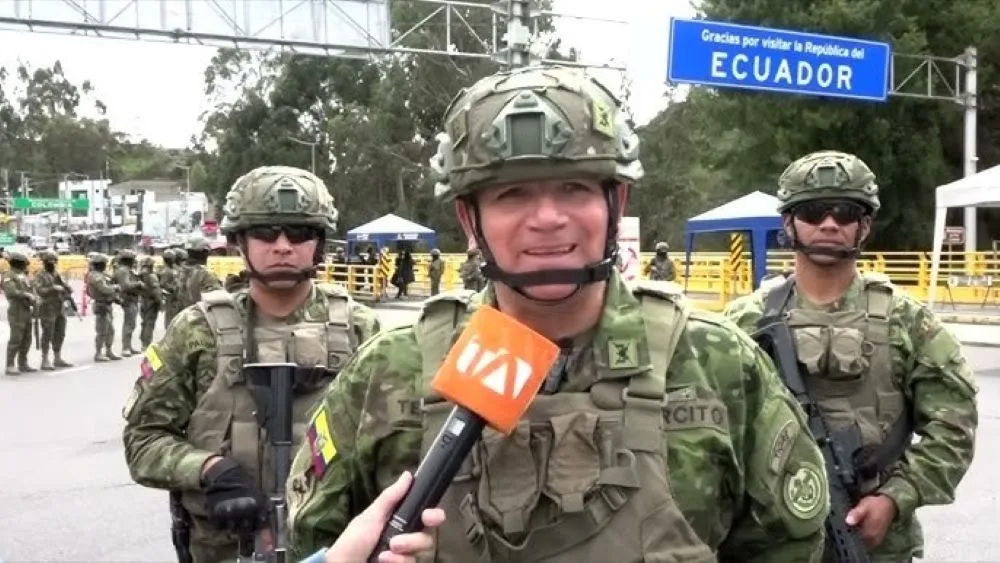
Leaked accreditation guidelines ignite debate over press freedom, security, and prior censorship during Ecuador’s internal armed conflict.
A directive that drew a hard line
A leaked internal directive from Ecuador’s Armed Forces has triggered a fierce national and international debate over press freedom, constitutional rights, and the limits of military authority during the country’s internal armed conflict. Signed on January 28, 2026, by the head of the Joint Command of the Armed Forces, Henry Delgado, the document outlines a system for evaluating and accrediting journalists and media outlets seeking access to military events, facilities, and operations.
At the heart of the controversy is a requirement that the Armed Forces assess media outlets based on their editorial stance, past coverage of the military, and whether their reporting is deemed compatible with the institution’s constitutional role. Media outlets judged to hold positions “contrary” or “detrimental to the image” of the Armed Forces could be denied access to coverage opportunities, according to the leaked text.
Press freedom advocates, constitutional lawyers, and international watchdogs have described the proposal as an unprecedented form of prior censorship, while the military insists the document is still under review and was never meant to restrict journalistic work.
The media evaluation matrix
The directive introduces a “Media Evaluation Matrix,” a scoring system designed to classify journalists and outlets on a 100-point scale. Six criteria are used, each assigned a specific weight: editorial line, historical news treatment of the Armed Forces, informational rigor, impact and audience reach, professional conduct, and recognition of the military’s constitutional role.
Outlets scoring between 80 and 100 points are deemed suitable for accreditation. Scores between 60 and 79 place a media outlet in a “conditionally suitable” category, while those below 60 are considered unsuitable and risk exclusion from coverage.
| Media Evaluation Matrix | ||||
| According to the Armed Forces, it is a tool for classifying the media. | ||||
| NUMBER | CRITERION | DESCRIPTION | WEIGHTING | SCALE |
| 1 | Editorial Line | Consistency with institutional and democratic constitutional values | 25 | 1 = Very unfavorable / 5 = Very favorable |
| 2 | Historical News Treatment | Analysis of past coverage on the Armed Forces | 20 | 1 = Repeatedly negative / 5 = Repeatedly positive |
| 3 | Informational Rigor | Use of verified sources and comparison of information | 20 | 1 = Low / 5 = High |
| 4 | Impact and Scope | Influence on public opinion, audience, and geographic coverage | 15 | 1 = Low / 5 = High |
| 5 | Professional Conduct | Respect for accreditation rules and conduct at official events | 10 | 1 = Poor / 5 = Excellent |
| 6 | Institutional Position | Recognition of the constitutional role of the Armed Forces | 10 | 1 = Delegitimizes / 5 = Fully recognizes |
Based on these scores, the document proposes maintaining two internal lists: one for accredited media outlets and another for “non-aligned” outlets, a label critics say effectively means media organizations that publish critical reporting. The text further states that access may be restricted for journalists accused of spreading false or decontextualized information or maintaining a systematic stance that affects public trust in the Armed Forces.
An exception is made for historically or emotionally charged events, such as commemorations of the Cenepa Conflict, where the directive suggests that critical media could be invited because it would be difficult for them to construct a negative narrative. In such cases, the document even proposes crafting messages that would compel critical outlets to highlight positive aspects of the institution, arguing that favorable coverage from traditionally critical media would carry greater public impact.
Legal and constitutional objections
Constitutional experts have warned that the proposed framework crosses clear legal boundaries. César Ricaurte, director of Fundamedios, described the directive as a textbook example of prior censorship, which is explicitly prohibited by Ecuador’s Constitution. Article 18 guarantees the right to seek, receive, and disseminate verified and contextualized information without prior restraint.
Constitutional lawyer Gandhi Vela explained that while the Armed Forces may regulate access to certain facilities for security reasons, they cannot condition access on a journalist’s editorial line or past reporting. Doing so, he argued, violates freedom of expression, freedom of thought, and the principle of equality and non-discrimination.
“This creates a message of ‘behave yourself if you want access,’” Vela said, warning that subjective criteria could be used to exclude critical voices. Another constitutional lawyer, André Benavides, went further, calling the proposal not only unconstitutional but historically alarming. He said he could not recall a similar attempt to rate and filter the press since Ecuador’s return to democracy in 1979, following nearly a decade of military rule.
International reaction and condemnation
The controversy quickly moved beyond Ecuador’s borders. On February 11, 2026, the Inter-American Press Association joined Human Rights Watch and the National Anti-Corruption Commission in condemning the Armed Forces’ proposed guidelines. The organizations characterized the measures as an attack on freedom of expression and a form of institutional intimidation.
The Inter-American Press Association warned that no state entity has the authority to decide which media outlets may cover public events based on their editorial stance, describing the system as prior censorship prohibited in any democratic society. Its president, Pierre Manigault, emphasized that allowing the Armed Forces to act as arbiters of acceptable journalism undermines pluralism and democratic accountability.
Human Rights Watch echoed those concerns. Juanita Goebertus, director of the organization’s Americas Division, stated publicly that excluding journalists because their reporting is considered damaging to the institution’s image filters the press by editorial line, punishes criticism, and seeks to control public discourse. She described such practices as typical of institutions that fear scrutiny rather than those committed to transparency.
The Armed Forces respond
After days of mounting criticism, the Joint Command of the Armed Forces issued a public response, asserting that the document circulating in the media is an internal draft that is not currently in force. In a statement posted on X, the institution said the text is still under development and subject to review by the Army, Navy, and Air Force, each of which must submit observations before any final version is adopted.
The Armed Forces described the leak as fraudulent and insisted that the intent of the draft is to establish objective security parameters to protect military installations, operations, and personnel, as well as civilians and journalists. According to the Joint Command, Ecuador’s current status as a non-international armed conflict requires heightened caution around sensitive information that could compromise operations if improperly disseminated.
Military officials denied any intention to censor the press, stating that the document does not violate freedom of expression or establish discriminatory criteria, and reaffirmed their respect for transparency and the role of journalism in a democratic society.
A broader climate of tension
The dispute over the directive has unfolded amid a broader period of strained relations between the government and the press. Earlier in January, a proposal from a lawmaker aligned with the governing party sought to amend the criminal code to impose jail sentences on journalists who criticize public officials, a measure that was later shelved after widespread opposition.
That same month, the Secretary of Public Administration publicly described herself as an “enemy of the media,” comments that drew criticism given ongoing scrutiny of alleged irregular land purchases involving politically connected figures. Press advocates argue that these episodes, taken together, reflect a growing discomfort with journalistic oversight rather than isolated missteps.
Why access matters
Critics warn that if such a vetting system had existed in the past, some of Ecuador’s most disturbing cases involving the Armed Forces might never have come to light. They point to incidents such as the disappearance and killing of four youths in Las Malvinas in December 2024, which ultimately led to the conviction of 16 soldiers, and the fatal shooting of 19-year-old Carlos Javier Vega during a military operation in February 2024, initially mischaracterized by authorities.
They also cite investigations into unresolved issues such as the non-operational radar on Montecristi Hill in Manabí, a strategic installation that exploded in November 2021 and has yet to be repaired despite allocated funds. In each case, sustained media scrutiny played a central role in informing the public and prompting accountability.
For press freedom organizations, the concern is not merely about access to military ceremonies or facilities, but about the precedent set when a state institution evaluates journalists based on how favorably they report. As one advocate put it, shielding public institutions from criticism does not strengthen democracy—it weakens it, quietly, from the inside.
0 Comments