
The energy minister says reservoirs and new generation will bridge a rainless start to 2026 as demand climbs.
As Ecuador slips deeper into its annual dry season, the country’s electricity system is again under the microscope, with falling reservoir levels in the southern Andes colliding with a government push to convince households and businesses that the blackout trauma of 2024 will not be repeated.
Energy and Environment Minister Inés Manzano has gone on the record repeatedly in early January insisting that rationing is not on the horizon, even as the giant Mazar reservoir, the backbone of the Paute-Molino hydroelectric complex, loses roughly a meter of water each day. “In 2024 there was no rain and there was no energy. In 2026 there is no rain, but there is energy,” she said, arguing that last year’s reservoir management and new generation coming online give the system a much stronger buffer this time around.
A reservoir under pressure
The concern centers on Mazar, which feeds Ecuador’s largest hydroelectric complex and acts as the main strategic water battery for the national grid. Cenace, the state electricity operator, lists its maximum operating level at 2,153 meters above sea level. On January 8th, it stood at about 2,137 meters after weeks of below-average rainfall in the southern highlands.
Engineers consider 2,115 meters the red line. Below that point, Mazar should be taken out of operation to prevent sediments from damaging turbines, a move that would immediately remove one of the country’s most important sources of hydropower from the system. With the reservoir dropping rapidly and the rivers that feed it running weak, the margin for error is thin.
In Cuenca and the surrounding basin, hydrometeorological stations show three of the four rivers that supply Mazar flowing at less than two cubic meters per second, an unusually low level for this time of year. The dry season, which normally stretches from September through March, did not bite hard in 2025 thanks to better-than-expected rainfall, but in 2026 it has arrived with force, reviving memories of the collapse two years earlier.
Demand, reserves and an uneasy math
Behind the political assurances lies a more complicated technical reality. Cenace estimates that Ecuador still needs to add about 866 megawatts of firm generation to meet demand and maintain minimum reserve margins without relying on imports from Colombia. That gap is what makes droughts so dangerous: when hydroelectric output falls, there is not enough reliable thermal or renewable capacity to fully replace it.
In December 2025, as rainfall began to fade, average hydroelectric generation slipped to about 2,781 megawatts per day. Analysts warn that if inflows continue to deteriorate through January, February and March and hydro output drops toward the levels seen in October 2024 — around 1,800 megawatts — the system would be pushed into deficit territory even if all available thermal plants and imports were running flat out.
Complicating matters further are projects that never arrived. Two plants contracted in 2024 with Progen and Austral, expected to provide 241 megawatts of new capacity, are still not in operation. Roughly 300 megawatts of Ecuador’s thermal “backup” also comes from rented equipment such as power barges, leaving the country dependent on leased assets rather than permanent infrastructure.
Betting on thermal recovery
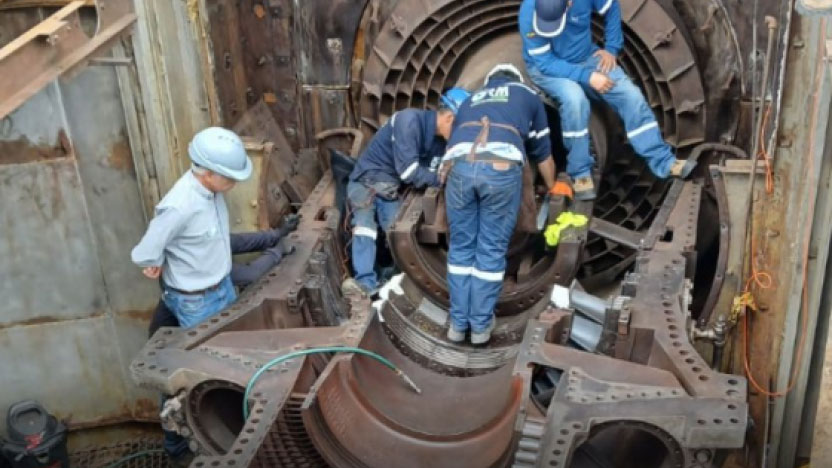
To offset those weaknesses, the government has leaned heavily on a crash program to revive long-idle thermoelectric plants. The most visible milestone came on January 9th, when the Álvaro Tinajero plant in Guayaquil returned to commercial operation after eight years offline. The facility adds 30 megawatts to the National Interconnected System following a roughly $6 million refurbishment that included mechanical assembly, testing and staff training.
That single unit is small, but symbolically important. With its return, the Electroguayas business unit now reports 617 megawatts of available thermal generation serving Guayas and Santa Elena, two of the country’s most energy-hungry provinces.
Since 2025, CELEC EP, the state electricity corporation, says it has recovered 280.1 megawatts nationwide through interventions at key plants. The Trinitaria station, for example, was lifted from 85 to 130 megawatts after a $18.1 million investment, while the TG-3 unit at the Aníbal Santos plant brought 18 megawatts back into service after being idle since 2022. Officials project another 154 megawatts of recovered capacity in 2026 as part of the same program.
Manzano has also pointed to about 300 megawatts of thermal and solar generation expected to come online this year, describing them as “firm energy” that will help insulate the grid from hydrological shocks.
World Cup season, high stakes
The timing adds another layer of sensitivity. The 2026 World Cup will run from mid-June to mid-July, a period when Ecuadorians traditionally see fewer blackouts because rains usually replenish reservoirs. In 2024, even after rationing began in April, June and July passed without major outages, allowing fans to watch football without interruption.
Officials are betting that 2026 will follow a similar pattern, provided the system can survive the current dry months without draining Mazar to its technical floor. For now, the government’s message is one of confidence, even as technicians and analysts quietly track every centimeter of falling water.
Whether Ecuador emerges from this dry season unscathed will depend less on slogans and more on how long the rains stay away, how fast thermal recovery translates into real megawatts, and whether the reservoir that anchors the national grid can hold out until the clouds return.
0 Comments