
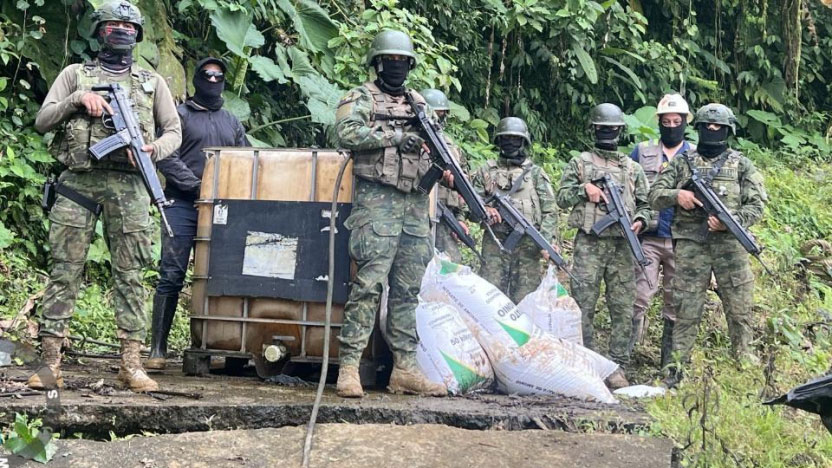
Criminal networks exploit gold boom, weak oversight and rural poverty to finance violence and corrupt state institutions.
Illegal gold mining has evolved into one of the most lucrative and destabilizing criminal economies in Ecuador, with armed groups carving out territorial control across multiple provinces and generating hundreds of thousands of dollars a day to finance violence, corruption and transnational crime.
Government officials now identify 36 critical illegal mining sites spread across 12 provinces, spanning the Coast, the Andes and the Amazon. What was once treated as an environmental offense has become a central pillar of organized crime, rivaling and in some areas surpassing drug trafficking as a source of income for criminal groups.
Speaking at the Annual Mining Meeting in Quito, Deputy Minister of Public Security Luis Fernando Pérez described a rapidly consolidating criminal landscape in which three armed groups dominate illegal mining operations in at least five provinces. These organizations control access to gold-rich zones, manage supply chains for fuel and chemicals, and enforce their dominance through intimidation, bribery and violence.
Armed groups and territorial control
Authorities say the Comandos de la Frontera operate primarily in Carchi and Orellana, regions that straddle sensitive border areas and jungle corridors. Their presence drew national attention earlier this year after they were linked to the killing of 11 soldiers during a military operation in Orellana, underscoring the growing firepower of mining-linked criminal groups.
Los Lobos, one of Ecuador’s most powerful criminal organizations, have entrenched themselves in Imbabura—particularly the Buenos Aires area of San Miguel de Urcuquí—and in southern Azuay, including the mining canton of Camilo Ponce Enríquez. Although their leader, Wilmer Geovanny Chavarria Barre, known as “Pipo,” was captured in Spain in mid-2025, officials say the group’s mining operations have continued largely uninterrupted.
In Esmeraldas, illegal mining activity is attributed to the Oliver Sinisterra Front, a dissident faction that emerged from the remnants of Colombia’s former FARC guerrillas. The group operates along river systems and forested zones, exploiting porous borders and long-standing smuggling routes.
A nationwide map of hotspots
Beyond these five provinces, illegal mining has taken root in areas long associated with gold extraction and informal mining. Hotspots have been identified in Napo, Morona Santiago, Zamora Chinchipe, El Oro, Loja, Cotopaxi and Sucumbíos, with activity concentrated around riverbeds, underground deposits and abandoned or disputed concessions.
In Morona Santiago alone, illegal mining has been detected in cantons such as Gualaquiza, San Juan Bosco, Taisha and Méndez, raising alarms over deforestation, mercury contamination and conflicts with Indigenous communities. In El Oro, historic mining centers like Zaruma and Portovelo remain under constant surveillance as authorities try to prevent the reoccupation of areas previously cleared by security forces.
Even where the state has regained control, officials acknowledge the risk of relapse. Buenos Aires, once a symbol of unchecked illegal mining, remains under military presence amid concerns that criminal groups are waiting for enforcement to loosen before returning.
Millions in profits fueled by gold prices
While the exact scale of the business is difficult to quantify, government estimates suggest illegal mining generates net profits of roughly $300,000 per day—more than $108 million annually. With global gold prices hitting record highs in 2025, officials believe the real figure could be significantly higher.
As of mid-December, a troy ounce of gold was trading above $4,200, nearly double its price at the start of the year. That surge has intensified competition for gold-rich land and increased the incentive for criminal groups to expand operations.
According to Pérez, between 20% and 30% of daily profits are reinvested into the mining business itself, allowing groups to purchase heavy machinery, explosives and fuel, while the remainder flows into other criminal activities, including arms trafficking, money laundering and bribery of local officials.
Legal concessions and blurred boundaries
The spread of illegal mining is occurring alongside a complex legal landscape. In the provinces affected, authorities have registered roughly 4,400 legal mining concessions covering more than 16,800 square kilometers. Most are artisanal or small-scale operations, but officials warn that criminal groups often exploit weak oversight to infiltrate or disguise illegal activity within legal frameworks.
Artisanal mining accounts for more than half of the concessions in high-risk provinces, followed by small-scale mining. Large-scale and medium-scale projects represent a much smaller share, but officials say even these can become targets for extortion or illegal encroachment.
Pérez warned that limited controls over the import and sale of heavy machinery have made enforcement more difficult. Excavators and other equipment, he said, have entered the country with insufficient oversight, prompting coordination with transport and infrastructure authorities to tighten regulations and improve tracking.
Police operations and seizures
So far this year, the National Police have carried out 398 operations against illegal mining nationwide. These interventions have resulted in 208 arrests and the dismantling or disruption of at least 55 organized crime groups linked to mining activities.
During the operations, police seized more than 264,000 kilograms of mineralized material, 133 pieces of heavy machinery, 169,000 explosives, dozens of weapons, nearly 800 rounds of ammunition and 48 vehicles. Officials describe the scale of the seizures as evidence of the industrial nature of illegal mining operations.
The chain-of-custody problem
Yet even successful raids have exposed vulnerabilities within the state. Pérez acknowledged persistent weaknesses in the storage and custody of seized mineralized material, which is transferred to warehouses while investigations proceed.
In several cases, authorities discovered that gold-bearing material had been replaced with ordinary rock—a practice known as the “switcheroo.” Prosecutors have opened cases against officials accused of facilitating or turning a blind eye to the theft, and responsibility for warehouse security has been placed on the Mining Regulation and Control Agency.
The issue has become a symbol of the broader challenge facing Ecuador: illegal mining is no longer just an environmental crime but a sophisticated criminal enterprise capable of corrupting institutions, financing violence and exploiting gaps in regulation.
President Daniel Noboa has repeatedly warned that unless the mining sector is brought under effective control, the state will struggle to contain organized crime. With gold prices high and armed groups deeply embedded across rural Ecuador, officials concede that the battle over illegal mining is likely to intensify before it subsides.
0 Comments