
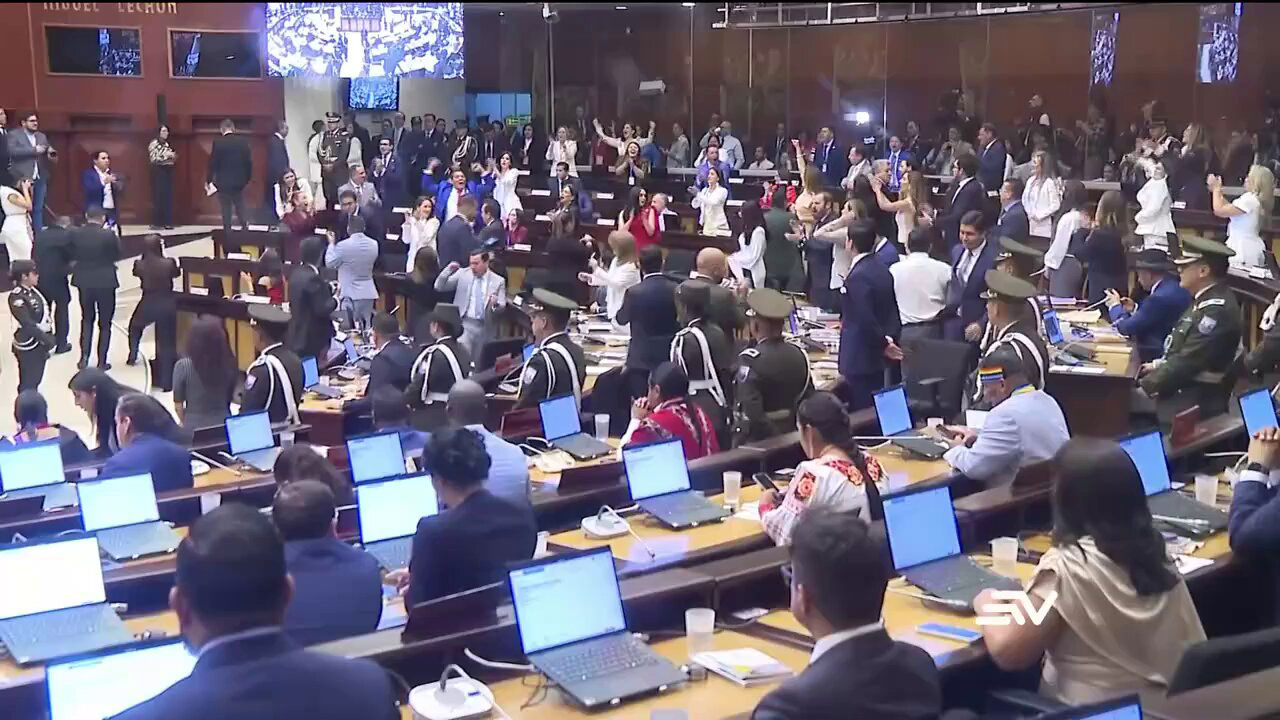
Recent votes in the Assembly reveal cracks in the ruling bloc’s once-solid control.
After the setback
The political aftershocks from the failed November 16th referendum are now shaking the National Assembly. National Democratic Action (ADN), the governing bloc that once moved confidently through the legislative agenda, is showing signs of vulnerability. Three recent votes exposed fractures and raised doubts about whether President Daniel Noboa can still count on a consistent majority.
Inside the party, lawmakers have avoided public reflection, opting instead for silence and tight messaging. That strategy collided with Noboa’s blunt admission on November 28th that the results represented a “shake-up” for his own ranks. His comment — suggesting that legislators had relied too heavily on the president to drive the campaign — was not welcomed by all.
“It has to be a joint effort,” Noboa warned, insisting that his allies walk, communicate, and campaign with the same intensity as the government itself. Some lawmakers interpreted this as the president shifting blame into the Assembly.
A majority, but less comfortable
Since the referendum, the Assembly has voted 17 times — and ADN prevailed in 14 of those with more than 80 votes. But those wins were mainly on low-stakes resolutions: oversight requests, support for services for people with disabilities, and reaffirmations of cooperation with the United States. Even the Citizen Revolution (RC) joined in backing many of those items.
The alarm bells sounded when politically sensitive motions — tied directly to the government’s rough political moment — came to the floor.
Missed votes and rising unease
The first sign of trouble came November 29th, when legislator Hernán Zapata pushed for debate on alleged irregularities in Quito’s municipal contracting. With tensions high between President Noboa and Quito Mayor Pabel Muñoz over suspended festivities contracts, the move could have been a symbolic victory for the ruling party.
Instead, it failed — by just two votes. Four allies were missing, including two ADN members, Eckenner Recalde and Dominique Serrano. They walked into the chamber moments too late, claiming they were performing legislative duties elsewhere. Inside ADN, the reaction was one of irritation — and worry.
Hours later, the 2026 Budget Proforma landed on the floor. Instead of the show of strength leaders hoped for — more than 80 votes — approval squeaked by with 78. One former Pachakutik legislator voted against the government’s plan, while two allies skipped the session entirely.
Then, on December 3rd, the Assembly debated a motion tied to cultural controversy: a performance titled ‘Aristocrats: Chronicles of an Uncomfortable Queer’ staged in the chapel of Quito’s City Museum. A resolution demanding protection of heritage spaces passed with 78 votes — but only because some allies reluctantly fell in line at the last moment. The votes were scattered, hesitant, and clearly lacking the discipline normally expected from a majority coalition.
A moment to exploit
As ADN regroups, others in the Assembly see opportunity. Independents and smaller factions, frustrated by being overshadowed, have begun quietly floating the idea of forming a new bloc. The potential lineup: provincial legislators, the remaining Pachakutik members, the three Social Christians, and several ex-Pachakutik lawmakers — around a dozen in total.
Their ambitions go beyond reshuffling the seating chart. Some want to reopen debates on previously approved reforms, particularly the shift to the D’Hondt allocation method in the Democracy Code — a change that reshaped the balance of electoral power.
But the same legislators exploring this new alliance are also wary of one another. Each has, at times, voted with ADN, and on other occasions sided with the Correista opposition. Trust, in short, is thin.
High stakes ahead
For Noboa, the timing couldn’t be worse. His administration hopes to return to constitutional reform through legislative channels — an option less risky than another national vote. But the numbers are unforgiving: a partial reform requires 77 votes — still within ADN’s reach. A constitutional amendment needs 101 votes — a level no faction can currently command.
As the political landscape shifts, the government’s majority looks less like a fortress and more like a fragile construction — one surprise absence or change of mood away from collapse. And all of it may determine whether Noboa can move ahead with the reforms he insists the country needs, or whether the shockwaves from November will keep shaking his administration long into the year ahead.
0 Comments