
Lawmakers clash over debt, social sector funding and investment as a narrow majority backs the plan.
A budget passed amid political friction
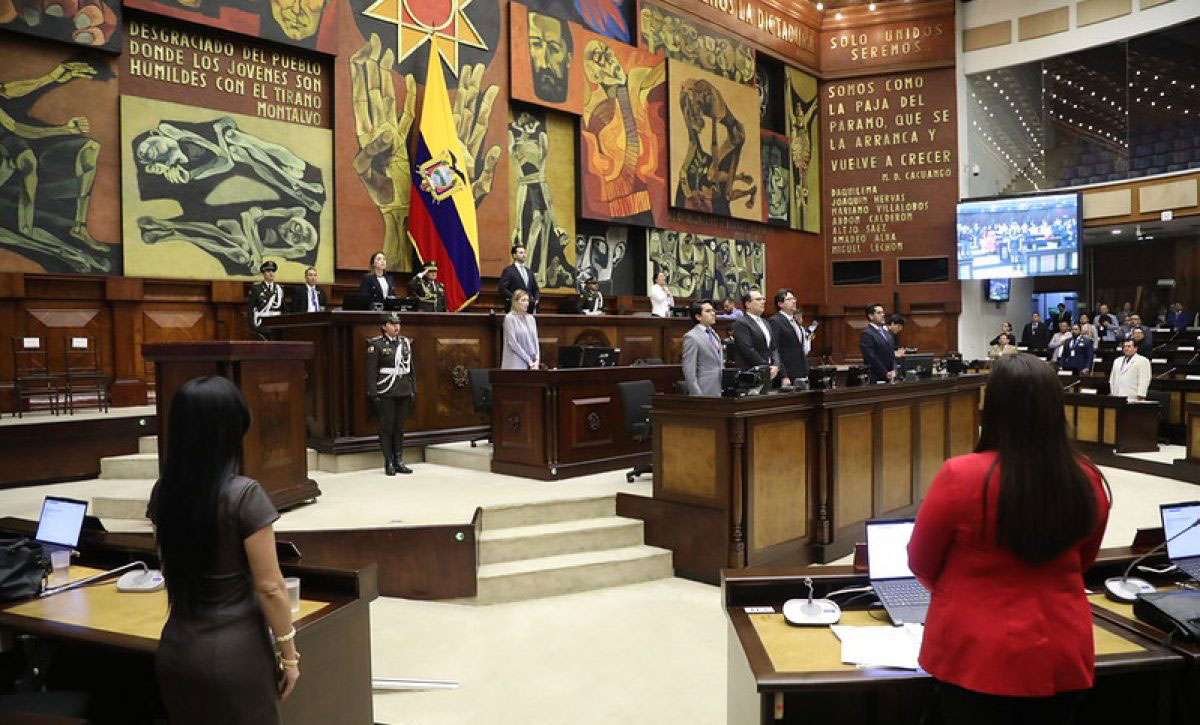
Ecuador’s National Assembly approved the 2026 General State Budget on Saturday afternoon, ending weeks of negotiation and public pressure surrounding one of the defining fiscal documents of Daniel Noboa’s administration. After three and a half hours of debate, the legislature endorsed both the annual budget and the 2026–2029 four-year plan, clearing the way for the government to begin next year with a financial blueprint that projects moderate economic growth and a significant deficit.
With 148 lawmakers in attendance, the budget passed with 78 votes in favor, 66 against, and four abstentions. Attempts by the opposition to force a reconsideration failed due to insufficient support.
Core assumptions behind the financial plan
The proposal delivered to the Assembly outlines the government’s expectations for an economy still navigating slow growth and volatile oil markets. Officials estimate nominal GDP at $139.046 billion for 2026, tied to a projected real growth rate of 1.8%. Oil production is expected to reach 165.5 million barrels, with an average selling price of $53.50 per barrel—well below the highs of previous years.
These assumptions shape the revenue estimate of $46.255 billion, made up of $21.679 billion in current income, $8.47 billion from capital sources, and $16.104 billion through financing.
On the spending side, the same amount is allocated: $23.482 billion for ongoing state operations such as salaries and services, $1.764 billion for public investment, and $10.495 billion in capital expenditures.
A deficit that remains difficult to close
The government foresees a global deficit of $5.413 billion, split between a $1.802 billion shortfall in permanent income versus permanent expenses, and a $3.611 billion gap in non-permanent accounts. To sustain state obligations and refinance debt, the budget includes a financing requirement of $10.512 billion, most of which—$8.351 billion—is earmarked for debt amortization.
Social spending and local government transfers
Despite tight fiscal margins, the budget outlines major commitments to social programs, social security, and decentralized governments. Current transfers amount to $6.252 billion, including $1.844 billion for assistance programs such as the Human Development Bond, Joaquín Gallegos Lara, the 1,000 Days initiative, My Best Years, and transportation subsidies. Another $3.852 billion supports the social security systems for civilians, police, and the armed forces.
The Annual Investment Plan totals $2.181 billion spread across 388 projects, with emphasis placed on energy, human development, security and strengthening public administration. Local governments will receive $4.113 billion in transfers, and the government maintains that mandatory pre-allocations in education and health will rise by $695 million for each sector.
To ensure compliance with spending commitments, the Economic Regime Commission plans to conduct monthly reviews of how institutions execute their assigned budgets.
Lawmakers sharply divided over priorities
The debate reflected the country’s ongoing political polarization. Members of the governing coalition defended the proposal as a necessary framework for stability and as a long-term strategy to confront insecurity. The opposition argued that structural weaknesses remain unresolved and that several sectors could face underfunding in practice, regardless of the official figures.
Assemblywoman Mónica Alemán accused the Executive of presenting a budget “born with illegal flaws,” alleging opacity in VAT allocation and arguing that debt payments had been elevated above urgently needed public works. She also questioned low execution rates this year in ministries such as Health, saying that poor performance undermines the credibility of next year’s projections.
Others focused on higher-education funding. Some opposition legislators insisted that nearly twenty universities would lose resources, a claim countered by Assemblyman Mario Zambrano, who said the approved plan actually raises higher-education funding by $59 million. Outside the Assembly building, students gathered to express concern about the potential impact on public institutions.
From another angle, PSC legislator Alfredo Serrano labeled the budget “unworkable,” criticizing what he described as unrealistic revenue expectations and an overreliance on borrowing. “They buy debt to pay off existing debt, not to build schools or roads,” he said, warning that the numbers risk failing almost immediately once 2026 begins.
Supporters emphasize security and stability
In contrast, independent Assemblyman Sergio Peña urged colleagues to view the plan as part of the country’s efforts to confront the rise in organized crime. “This budget addresses the root causes of crime,” he said. He argued that while debate is healthy, lawmakers should prioritize equipping the government with the financial tools needed to carry out its strategy in security, social development, and economic recovery.
The approval sets the stage for a crucial fiscal year ahead—one that will test the administration’s capacity to balance debt obligations with the demands of a country calling for improved services, stronger institutions, and sustained investment in public safety.
0 Comments