
Government and local leaders reached a truce to reopen roads and begin talks, but national leaders and some communities reject the accord
Talks in Otavalo bring temporary calm
After 24 days of road closures and violent clashes, the government of Ecuador and local indigenous leaders in Imbabura reached an agreement on October 15th to lift the strike that had paralyzed the province. The decision followed more than four hours of closed-door talks in Otavalo between Interior Minister John Reimberg, representatives of indigenous organizations, and members of the Catholic Church, who acted as mediators.
Reimberg announced the agreement as a step toward restoring peace in the northern Sierra. “Today the strike is lifted, today the roads are opened,” he declared, emphasizing that the government would immediately work to resupply the province and launch technical working groups next week. “We are a country of peace, and we must work that way,” he said.
The meeting included leaders from the Federation of Indigenous and Peasant People of Imbabura (FICI) and the Union of Indigenous Peasant Organizations of Cotacachi (Unorcac). Together, they agreed to reopen roads, resume supplies, and continue dialogue through technical committees that will address local priorities such as road infrastructure, water, education, and health.
Fuel subsidy remains unchanged
While both sides hailed the truce as a breakthrough, the government reaffirmed that Decree 126, which eliminated the diesel subsidy, remains in effect. The measure, implemented by President Daniel Noboa on September 12th, raised the price of diesel from $1.80 to $2.80 per gallon, triggering protests nationwide led by the Confederation of Indigenous Nationalities of Ecuador (Conaie).
According to the Ministry of Government, “the policy to control and combat fuel smuggling and illegal mining remains unchanged.” Officials insisted that the government’s commitment to dialogue does not mean reversing fiscal reforms aimed at reducing fuel subsidies.
Manuel Catucuago of the FICI said indigenous leaders proposed freezing diesel prices as a compromise, but this was rejected by government negotiators. Instead, both sides agreed to create territorial roundtables to study social and economic impacts and explore possible adjustments in the future.
Demands for justice and detainee transfer
Among the conditions for lifting the strike were the transfer of 12 people detained during the protests from Portoviejo Prison to Ibarra Prison, closer to their families. The transfer took place on the evening of October 15th, with an appeal hearing scheduled later in the week to review their pretrial detention.
Indigenous representatives also demanded investigations into the deaths of two protesters and an end to what they called “unfounded judicial accusations” against community leaders. They requested medical care for the wounded, the withdrawal of security forces from indigenous territories, and a public apology for labeling demonstrators as “terrorists.”
Fausto Jarrín, a government advisor and former legislator, participated in the meeting alongside Reimberg. Parish priest Cristian Andrade of Otavalo was appointed to oversee compliance with the agreement.
Mixed reactions among indigenous communities
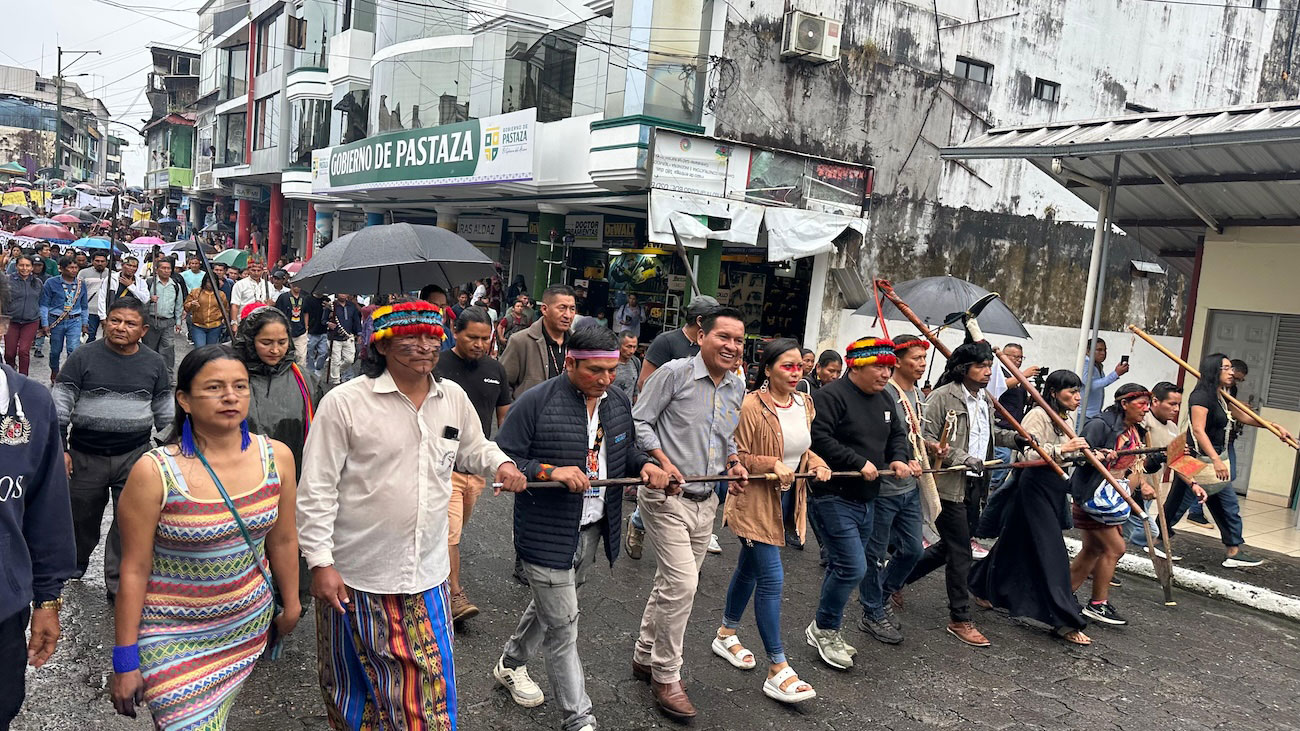
Despite the announcement of peace, divisions quickly surfaced within Imbabura’s indigenous movement. While FICI and Unorcac leaders confirmed the lifting of roadblocks, other groups — including the Kichwa Karanki people — rejected the accord, declaring they would “remain in firm resistance.”
On the night of October 15th, hundreds gathered in downtown Otavalo to protest what they described as a premature truce. “How is it possible that they come and tell us to leave our territory? We live here; the territory is ours,” said community member Pacha Terán. Demonstrators chanted “Long live the strike!” and called for the repeal of the decree eliminating the subsidy.
Otavalo Mayor Anabel Hermosa urged the bases to respect their leaders’ authority but acknowledged the tension between local leadership and grassroots assemblies. She convened a new meeting with community representatives for October 16th, calling for renewed dialogue “so that decisions are taken collectively.”
Streets reopen, but calm is fragile
By the morning of October 16th, the streets of Otavalo were quiet but subdued. Businesses remained closed, and ECU 911 continued reporting roadblocks in parts of the province. Although no new clashes were recorded, several communities in Peguche, Karanki, and Cotacachi announced they were maintaining permanent assemblies until their demands were addressed.
Minister Reimberg reiterated that the government “will not back down” on the elimination of the subsidy but promised continued coordination to support economic recovery in the province. “Dialogue to build a better future has always been on the table,” he said.
For local merchants and transport operators, the reopening of the roads was a relief after weeks of paralyzed commerce. Yet for many indigenous communities, the agreement marked only a pause — not an end — to a conflict over fuel prices and social policy that continues to test the government’s ability to maintain both fiscal discipline and social peace.

0 Comments