
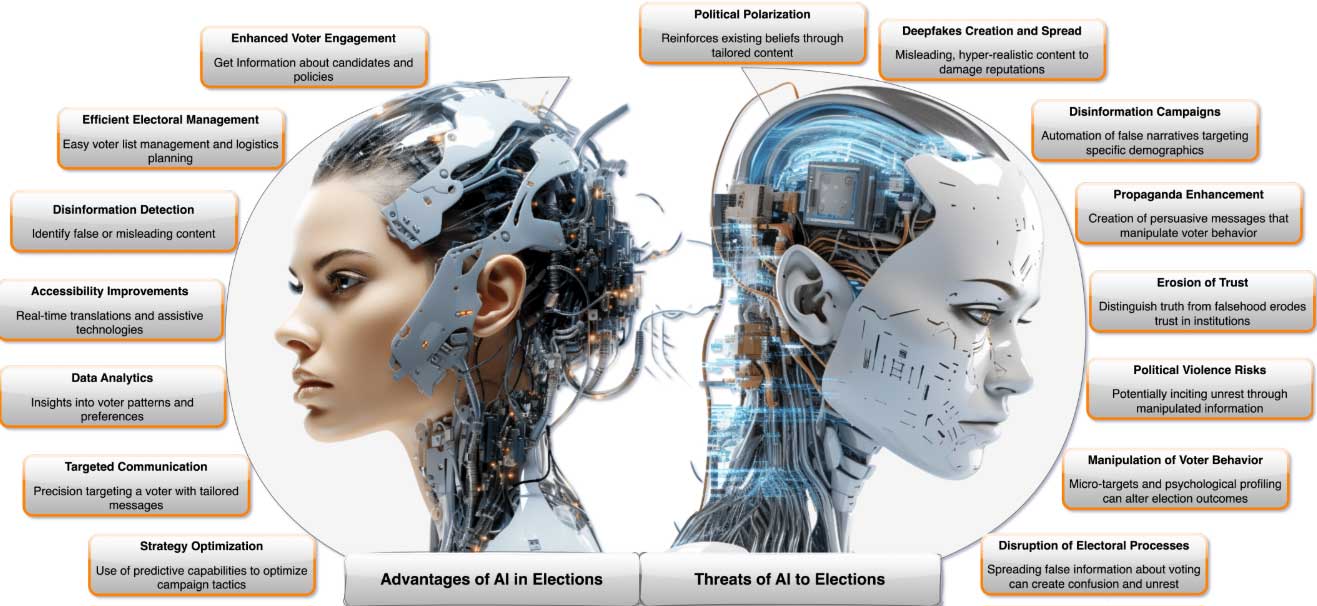
Artificial intelligence has become an invisible player in Ecuador’s presidential campaign, fueling a new era of sophisticated electoral deception.
As Ecuador prepared to elect its next president on Sunday, February 9th, an unprecedented wave of AI-generated disinformation swept through social media, targeting the leading candidates with hyper-realistic fabricated content. Experts say the campaign’s use of deepfake technology surpasses what has been seen in many other Latin American elections, reflecting both its increasing accessibility and its potential as a powerful tool for manipulation.
A New Battleground for Disinformation
The widespread circulation of AI-altered videos—where voices, lip movements, and entire news reports have been convincingly faked—has put misinformation at the heart of the election. These deceptive tactics have primarily been used to undermine leftist candidate Luisa González and incumbent President Daniel Noboa, both of whom led in the polls.
One of the most striking examples of AI-driven disinformation emerged after Venezuelan President Nicolás Maduro began his new term. A viral video appeared to show González praising Maduro’s leadership, calling him “a great president.” However, digital forensics confirmed it was an AI-generated deepfake.
“This technology is capable of cloning voices and synchronizing lip movements with incredible precision,” explained Marco Benalcázar, head of the Alan Turing Artificial Intelligence and Vision Research Laboratory at Ecuador’s National Polytechnic School. “It can take as little as an hour to create a convincing deepfake, depending on the complexity of the setup.”
AI-Generated Fake News Reports
Beyond altering candidate statements, deepfake technology has been used to fabricate entire news broadcasts. Fake reports attributed to well-known international networks, such as CNN and NTN24, have falsely implicated both González and Noboa in scandals.
One deepfake video, designed to appear as an NTN24 report, falsely claimed Noboa had paid $1 million to attend Donald Trump’s inauguration. Another AI-generated clip made it seem as if CNN anchor Fernando del Rincón had linked González to criminal activity.
“People are used to questioning text-based disinformation and photoshopped images,” said Carlos Rodríguez Pérez, a communications professor at Colombia’s University of La Sabana. “But deepfakes present a new challenge because they feel immediate and real. Many social media users don’t take the time—or have the tools—to verify authenticity before sharing.”
A Coordinated Strategy
Experts say the use of AI-generated disinformation in Ecuador’s election is no accident. Unlike random rumors or poorly edited hoaxes, deepfake videos require planning, funding, and strategic intent.
“This is a calculated effort to delegitimize opponents,” Rodríguez noted. “Deciding which politician to target, which statement to fake, and which news outlet to impersonate—these aren’t random choices. They’re carefully designed to influence public perception.”
The Ethical Debate
Despite its misuse in political deception, experts argue that artificial intelligence should not be villainized.
“Technology itself is neutral,” Benalcázar emphasized. “It’s how we use it that determines whether it’s beneficial or harmful. AI has tremendous potential to solve real problems, but disinformation is one of its darker applications.”
As Ecuador’s election turns to a runoff, the rise of AI-generated disinformation serves as a stark warning: the battle for truth in political campaigns is becoming more complex, and voters must remain more vigilant than ever.
0 Comments