
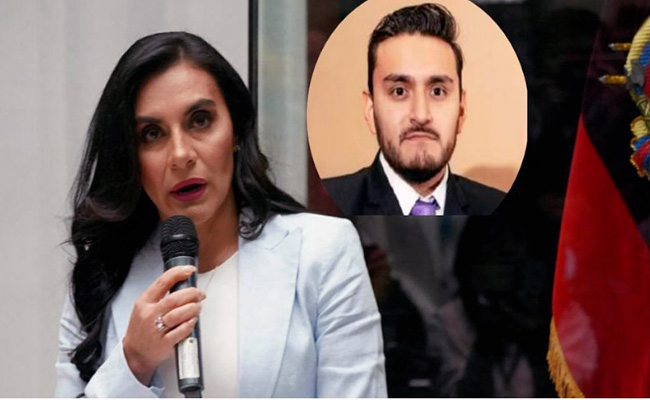
Ecuador’s Vice President’s son and former adviser face corruption charges in a case involving influence trafficking.
Ecuador’s political landscape faces renewed scrutiny as the judicial proceedings in the high-profile “Nene” case move closer to a pivotal decision.
Central to the case are allegations against Francisco Sebastián B., the son of suspended Vice President Verónica Abad, and her former adviser, Daniel Lenin R. Both stand accused of engaging in influence trafficking, a serious crime that carries a penalty of three to five years in prison under Ecuadorian law.
The allegations surfaced following a complaint from Romel P., a former employee of the Vice President’s office, who claimed he was pressured to surrender a portion of his future salary in exchange for a key government role.
The complaint, which also implicated Vice President Abad herself before she was granted immunity by the National Assembly, has cast a shadow over the office’s integrity.
Accusations of Coercion and Corruption
The case dates back to March 2024, when Francisco Sebastián B. was arrested in Cuenca on charges of influence trafficking.
According to the prosecution, Romel P. was offered the role of Communication Coordinator in the Vice President’s office with a monthly salary of $3,200. However, the offer allegedly came with a stipulation: he was required to surrender $1,500 of his salary each month to the accused.
Prosecutor Leonardo Alarcón, who presented 54 pieces of evidence against the defendants, argued that the scheme demonstrated clear intent to exploit public office for personal gain. Alarcón further revealed that a letter of guarantee for $30,600 had been coerced from Romel P. as part of the arrangement, though the complainant was ultimately dismissed from his role before any payments were made.
Despite these accusations, the defense for both Sebastián B. and Daniel R. has vehemently denied the charges, describing the evidence as circumstantial and riddled with inconsistencies.
They argue that the case is politically motivated, with Francisco Sebastián B.’s lawyer, Oswaldo Trujillo, pointing to contradictions in the complainant’s testimony, including discrepancies in meeting dates and the lack of corroborating evidence for key claims.
Judicial Decision Approaches
Anti-corruption judge Karol Zambrano is set to announce her decision on November 19th regarding whether to formally bring Sebastián B. and Daniel R. to trial. The outcome could have significant implications, not only for the accused but also for Vice President Abad, whose political career has already been marred by the controversy.
The Vice President herself was initially named in the case but was shielded from prosecution when the National Assembly upheld her immunity in June. This development has fueled criticism from opposition figures, who argue that the Assembly’s decision undermines efforts to combat corruption at the highest levels of government.
If the case proceeds, it will be heard by a criminal court, with the focus on determining whether the actions of Sebastián B. and Daniel R. constitute a violation of Article 286 of Ecuador’s Comprehensive Criminal Organic Code, which addresses influence trafficking.
Political Fallout
The “Nene” case has become emblematic of broader concerns about corruption in Ecuadorian politics. Critics suggest that the allegations against Vice President Abad’s inner circle reflect a systemic issue, where power and privilege are leveraged for personal enrichment.
As the nation awaits Judge Zambrano’s decision, the case continues to draw widespread attention, serving as a litmus test for the judiciary’s commitment to accountability and transparency.
Regardless of the outcome, the scandal has already left an indelible mark on the Vice President’s office, raising questions about the ethical standards expected of public officials in Ecuador.
0 Comments